JANUARY 2006
Mayan City that existed without religion or the religious terrors of other Mayan regions
Cancuen: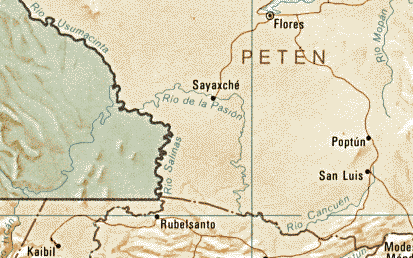
Archaeologists in
Guatemala say they have found an ancient palace which is
forcing scholars to reconsider their ideas about the
Mayan civilisation, which was prevalent before the
arrival of the Spanish in Central America.
The limestone building, which dates from the eighth century, has more than 170 rooms arranged around 11 courtyards.
Experts say the elaborate nature of the palace suggests it was actually built during a time of peace and relative economic stability when it had been thought that most cities in the area were at war with one another.
Recently discovered references to Can Cuen's importance as a trading centre forced researchers to look more closely at the site.
Archaeologist Arthur Demares, from the Vanderbilt University in the US, was leading the expedition. He said they had been at the site two weeks without realising the extent even of the main palace buried in the jungle.
One day he was walking along the palace's highest level when he fell up to his armpits in vegetation that had filled a hidden courtyard.
"That's when I realised the entire hill was a three storey building, and we were walking along the top of the roof," Professor Demarest said.
One of Guatemala's foremost authorities on deciphering Mayan hieroglyphics, Frederico Fahsen, said that most Mayan kingdoms relied on religion and warfare for their power but it seems that Can Cuen kings thrived for more than 1,000 years on commerce alone using their wealth to forge alliances with neighbours.
"Mayan cities were in a constant state of war with their structures dedicated to the Gods in heaven. Now we've discovered something exactly the opposite," Mr Fahsen said.
A grave containing some 50 bodies, buried in royal finery and bearing the marks of a vicious death, has been perplexing experts since it was unearthed earlier this year.
These are not the victims of "random violence", says Arthur A Demarest, the US archaeologist who has spent the best part of a decade fending off drug lords and looters as he excavated the site.
"You find war captives decapitated but not mass executions like this," he told the BBC News website.
Sudden collapse
Most remarkably for Dr.Demarest, the attackers chose to abandon the site - the ancient trading city of Cancuen, grown rich through its position at the point where the river Pasion becomes navigable.
As a result, the city abruptly
lost its status as a key trading post along the Pasion,
the river regarded as the lifeblood of the Mayas
This trade route dies and never comes back," he
said, adding that Cancuen's collapse foreshadowed the
decline of other cities along the river.
Preserved Mural Unearthed in Guatemala
Discovery Verifies Mayan Civilization 2,000 Years Ago
By Guy GugliottaWashington Post Staff
Writer
Wednesday, December 14, 2005; Page A03
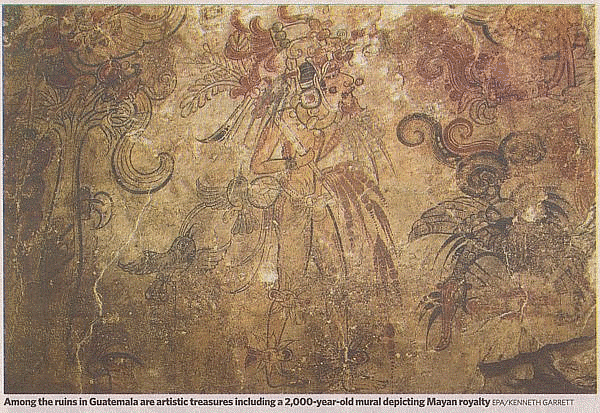
Archaeologists have uncovered an elegantly painted 30-foot-long mural in a ceremonial chamber beneath a Guatemalan jungle pyramid, providing new evidence that Mayan civilization was in full flower more than 2,000 years ago.
Archaeologist William Saturno of the University of New Hampshire and Harvard's Peabody Museum of Archaeology and Ethnology said yesterday that the San Bartolo site, in Guatemala's Peten wilderness, is "the find of a lifetime," depicting the Mayan creation myth and the crowning of a king in vivid color on a plaster wall as though "parts of it . . . were painted
The painting is the oldest intact mural ever found in Meso-America, dating to about 150 B.C. in the Mayan "pre-classic" period. But the subject matter has the same breadth of mythology and cultural complexity as that displayed at "classical" Mayan sites nearly 500 years later.
"This verifies what we had long suspected -- that Mayan civilization had crystallized by the time" the San Bartolo site arose, said University of Pennsylvania archaeologist Robert J. Sharer, author of "The Ancient Maya." "The institution of divine kingship is in place -- the imagery is consistent with later times. It's a terrific find."
Saturno discovered San Bartolo in 2001 when he took refuge from the tropical heat by ducking into a looters' trench cut into the back of a jungle-covered pyramid in northern Guatemala, near the Mexican border. He found himself inside a chamber choked with landfill. But the north wall revealed a four-foot-long swath of beautifully preserved mural depicting the resurrection of the Corn God, a scene from Mayan creation myth.
"As spectacular as this was," Saturno said during a telephone news conference organized by the National Geographic Society, "we knew that the west wall was more than twice its length and was the centerpiece of the ancient room."
And so it proved. The 30 feet of west wall mural, the excavation of which began in 2004, shows the son of the Corn God establishing land, water and air, and paradise in the east where the sun rises. The next section shows the Corn God's coronation, followed by death and resurrection. The last section shows the coronation of a Mayan king, claiming his crown in the company of the gods.
While the north wall was painted in black, red, yellow and pink, the west wall added several shades of blue, white, and dark and light gray. "The murals were painted at the same time, but there's more than one artistic hand," Saturno said. National Geographic magazine is profiling San Bartolo in next month's issue.
Three doors into the chamber were on the now-destroyed east wall, making the west wall the first and most arresting sight for new arrivals. "Our best guess is that this was a preparation room, where the king would rehearse the mythology for ceremonies" outdoors, Saturno said.
The murals are accompanied by archaic Mayan writing as sophisticated as later classic glyphs that have been deciphered, but "the pre-classic is a different system," said archaeologist Richard D. Hansen of Idaho State University. "We can't make sense of it until we have [more samples], but we're getting into it."
The murals, three feet tall and painted on layers of plaster smoothed over foundation stone, survived for centuries in the coolness beneath the pyramid, with the chamber filled with earth containing thousands of mural fragments from the east and south walls.
About a mile from the pyramid, a team led by Guatemalan archaeologist Monica Pellicer Alecio in 2004 began excavating a vaulted tomb containing a man's remains and a large jade plaque, the symbol of Mayan royalty.
Saturno said the story told by the murals and the presence of a nearby royal burial site demonstrate a fully developed Mayan political hierarchy in a relatively small place at a time when the area was probably dominated by the large city of El Mirador about 60 miles away.
"But it's all there in San Bartolo
too," said Hansen, an El Mirador specialist.
"The pre-classic was a complex and sophisticated
society, and this is the greatest compilation of murals
ever found in Meso-America. It's a wonderful opportunity
for scholars."
More on Archaeological Research:
Huge
cities were swallowed up by the jungle, and Mayan wisdom
and knowledge was lost to mankind for centuries. What
brought down this thriving society, which had survived
and prospered for millennia?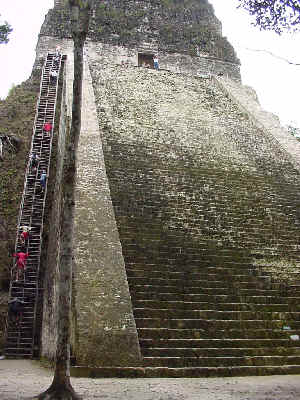
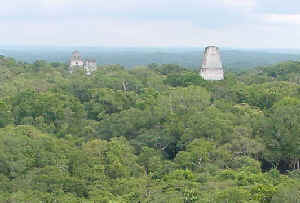 But
1,200 years ago, Tikal was one of the major cities of the
vast and magnificent Maya civilisation that stretched
across much of what is now southern Mexico, Belize and
Guatemala. Tikal was home to perhaps 100,000 people.
Thatched farmsteads and fields would have stretched as
far as the eye could see.
'Their
civilisation was so stable and established, they even had
a word for a 400-year time period.'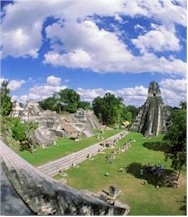
The Maya thrived for nearly
2,000 years. Without the use of the cartwheel or metal
tools, they built massive stone structures. They were
accomplished scientists. They tracked a solar year of 365
days and one of the few surviving ancient Maya books
contains tables of eclipses. From observatories, like the
one at Chichen Itza, they tracked the progress of the war
star, Venus.
They developed their own mathematics, using a base number of 20, and had a concept of zero. They also had their own system of writing. Their civilisation was so stable and established, they even had a word for a 400-year time period.
Mayan society was vibrant, but it could also be brutal. It was strictly hierarchical and deeply spiritual. Humans were sacrificed to appease the gods. The elite also tortured themselves - male Maya rulers perforated the foreskins of their penises and the women their tongues, apparently in the hope of providing nourishment for the gods who required human blood.
In the ninth century, the Maya
world was turned upside down. Many of the great centres
like Tikal were deserted. The sacred temples and palaces
briefly became home to a few squatters, who left
household rubbish in the once pristine buildings. When
they too left, Tikal was abandoned forever, and the Mayan
civilisation never recovered. Only a fraction of the Maya
people survived to face the Spanish conquistadors in the
16th century.
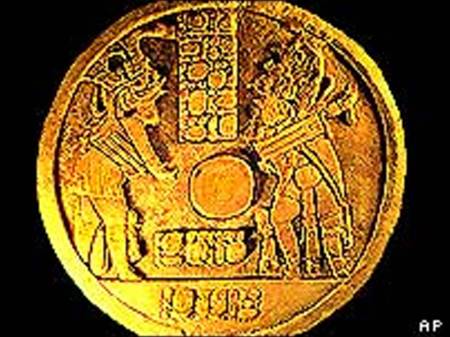
The 600-pound (270-kg) altar, which had been missing for two years, has been hailed as a masterpiece of Mayan art.
It was erected in the year 796 in the city of Cancuen, at the site of one of the Mayans' largest royal palaces.
But after the demise of the Mayan civilisation, it lay unknown and undisturbed until 2001, when a rainstorm washed away layers of dirt that had been covering it.
A local gang of looters spotted it and hauled it away on a boat.
In an effort to find a buyer, they took photographs of the altar and distributed them, but an offer of $4,000 by local drug traffickers was rejected as insufficient.
At that point, confusion set in as different groups of looters and drug traffickers fought for possession of the altar.
After a group of masked men
raided a village near the site in a fruitless search for
the artefact, village elders alerted archaeologists, who
teamed up with Guatemalan federal police to track down
the altar.
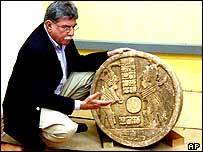
The altar depicts Cancuen's greatest king, Taj Chan Ahk Ah Kalomte, playing handball with another king in a ritual formalisation of an alliance.
It was originally placed at one end of the royal ball court.
"The importance of the
altar is scientific and archaeological, and it happens
also to be a masterpiece of Mayan art," said
archaeologist Arthur Demarest, who has worked with the
local Maya for more than 20 years. Historians say they
hope that text on the altar will reveal much about the
end of the Mayan civilisation.
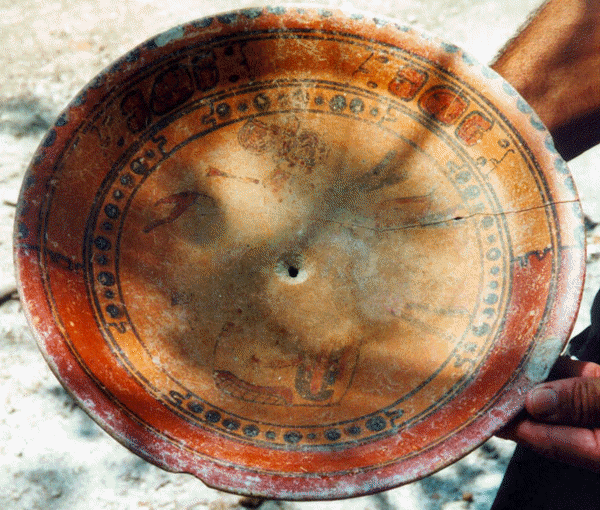
...................................................................................................................
Peter Mathews,
an epigrapher of international reputation and MacArthur
awardee, had been excavating at El Cayo, an ancient Maya
site on the lower Usumacinta River 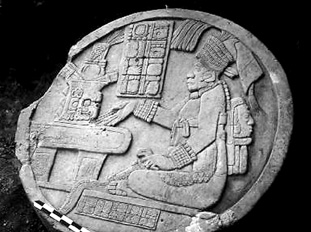 (bordering Mexico and
Guatemala) since 1992. The site is located between the
Maya cities of Yaxchilán and Piedras Negras in one of
the more remote corners of the Maya Lowlands, an area
accessible only by boat or aircraft. Although the site
extends on both sides of the river, Mathews's work had
concentrated on the portion in Chiapas, Mexico. Mathews's
1993 excavations revealed Altar 4, a beautifully
preserved monument inscribed with fine hieroglyphic texts
and relief sculpture. The text on Altar 4 indicates that
the monument was carved to commemorate a 20-year katun
ending (9.15.0.0.0), celebrated in the year 631 by the
67-year-old Ah Chak Wayib ("The Great
Dreamer"), a sahal, or underlord of the king
of Piedras Negras.
Both the carving and the inscription were beautifully executed and wonderfully preserved. While this made the monument valuable for scholarship, it also made it a target for looting. The plundering of archaeological sites in the Maya Lowlands is extremely bad, especially in inaccessible regions of Chiapas and the Petén.
DROUGHTS
Researchers at the University of Florida, US, analysed sediments from a lake on the Yucatan Peninsula in Mexico and found a pattern of drought repeating every 208 years.
The pattern matches a cycle of brightening and dimming in the Sun.
Sediment sample
"It looks like changes in the Sun's energy output are having a direct effect on the climate of the Yucatan and causing the recurrence of drought, which is in turn influencing the Maya evolution," said David Hodell, lead author of the study.
In 1993, Professor Hodell and his colleagues extracted a sediment sample from Lake Chichancanab in northern Yucatan documenting 9,000 years of climate history.
They found that the driest period of the current era was from AD 800 to 1000, coinciding with the collapse of the classic Mayan civilisation in the 9th Century.
This time they went back to the
lake and found data that backed up their findings and
pointed to other periods of drought coinciding with other
declines in Mayan building activity. 
They found evidence for major
dry periods between 475 and 250 BC, and AD 125 and 210,
which, they believe, coincides with the abandonment of
pre-classic Mayan sites in the Mayan Lowlands.
| But other
climate researchers using tree ring dating
(dendrochronology) have also found evidence of a
bicentennial drought cycle in step with the
variation of the Sun. The research appears in the journal Science. EK BALAM, MEXICO : recent work uncovered some other interesting treasures including a mysterious pair of small twin pyramids. These buildings were built with astrological precision in mind. The two pyramids are joined with a steep split down the middle. When the sun rises at the spring equinox on the 21 March, the rays fall directly through the schism. When it sets that night, the last rays of sunset fall back through the split in the other direction. Archaeologists are looking for funds in order to resume work at Ek Balam. They think there is still a lot to be discovered in the city of the black tiger. |
 |
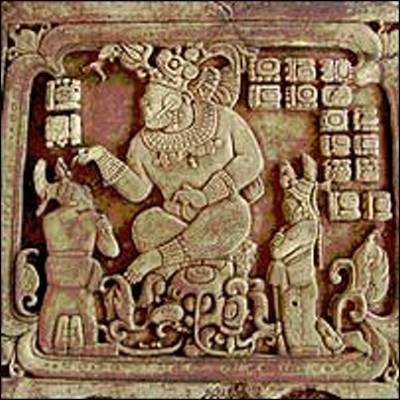
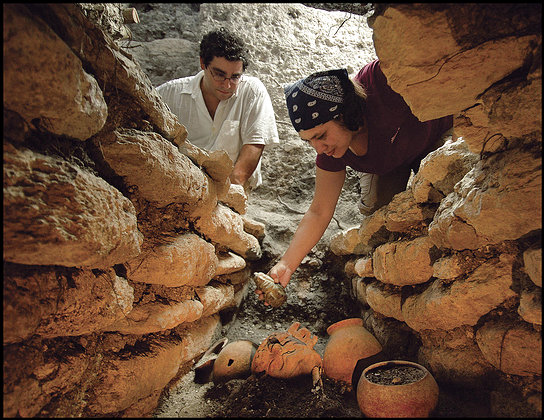
The ancient city of Cival:Elaborate ritual objects and carved masks have been uncovered in the ancient ruins of a city in Guatemala.
Exploration of the 2,000-year-old site has caused archaeologists to question the established chronology of the enigmatic Maya civilisation.
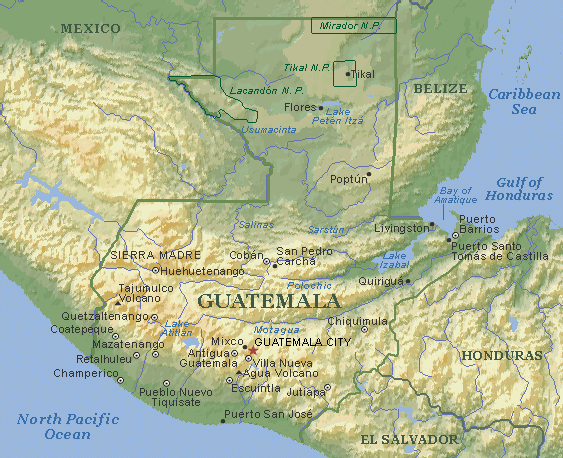
The ancient city of Cival, in Guatemala's Peten region, was first mapped by the explorer Ian Graham in 1984. Since 2001, it has been the focus of an exhaustive excavation, led by Francisco Estrada-Belli, of Vanderbilt University in Tennessee, US.
His team's discoveries have included two monumental carved masks, 120 pieces of polished jade, a ceremonial centre that spanned 800m (2,600ft) and an inscribed stone slab dating to 300 BC.
Maya deity
Cival had pyramids and a large complex surrounding a central plaza. The buildings were carefully positioned so they faced the sunrise in the equinox. According to Professor Estrada-Belli, this suggests they were used to measure time.
"It had an important astronomical function," Professor Estrada-Belli said. "It's not coincidence that the central axis of the main buildings and the plaza is oriented to sunrise at the equinox."
Strictly speaking, Cival flourished in the pre-classic period, which stretches from 2000 BC to AD 240. But it was more advanced than pre-classic societies were thought to be.
It had kings, complex iconography, grand palaces, writing and polychrome ceramics: all the hallmarks of the later - and apparently more civilised - classic period.
"It is pretty clear that 'pre-classic' is a misnomer," said Professor Estrada-Belli. "It's very interesting when we reverse some existing ideas. We thought the pre-classic Maya were a relatively simple society - and they were not."
"There was a whole civilization during the pre-classic time we are just beginning to recover," he added.
MODERN MAYAN LIFE:
First the Mayans suffered Spanish colonial cruelty and then it was the civil war between the military regime and the left-wing guerrillas.
He rattles off the figures which are now on everybody's lips: "Nearly a quarter of a million people dead, one million displaced - most of them Mayans."
Elvira, a young Mayan woman attaches herself to me, and we speak in French - which she is studying because she likes the sound of it - not because she has aspirations in the outside world. Like most Mayans she is passionately attached to her village.
Reading the
cloth
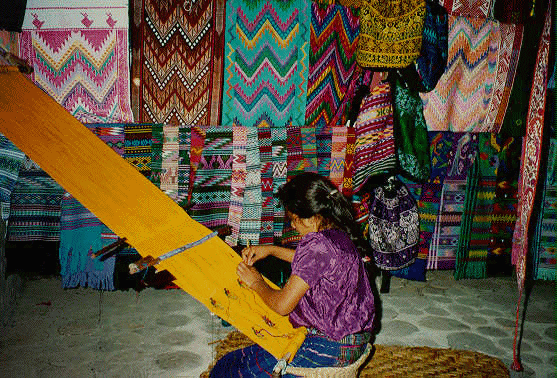
Elvira explains that each village has its own method of weaving and its own designs and colours - so the variety is dazzling.
"You have to read the cloth, like reading a book," she tells me.
"Look at that woman over there," she points. "You can tell she's from the shores of Lake Atitlan".
The woman's blouse is a purple-striped white cloth embroidered with flamboyant images of birds, animals and flowers.
Elvira's mother, who is sitting in the shade of her stall, is weaving on a small hand loom. She has made Elvira's huipile of bright greens and purples - two months of patient labour. And she's taught Elvira.
"All my friends weave!" Elvira laughs. She's also the first person in her family to go to university.
"Weaving and slaughtering chickens are as important as learning French, especially if I want to get a man one day!"
Elvira's father was murdered by the military in the early 80s and her mother has brought up four children by herself. Guatemala's new democracy has at last granted them equal rights with the ruling Latinos, and their languages and customs are thriving. Wearing their own clothes is part of their defiance and identity.
Elvira's on a roll now, keen to practise her French and educate me in textile anthropology.
"All the patterns on my blouse - these plants and animals - are linked to our love of nature. Mayans are very spiritual people."
Their spiritual leader is the shaman or priest and Elvira visits her local priest most weeks - sometimes just to help get rid of a headache.
She leads me through the market to visit him. He performs his mysterious ceremony in a black embroidered jacket and peacock-bright headdress.
This is the shorter "tourist ceremony" and afterwards he changes into jeans and T-shirt - and looks very relieved. "Western clothing is so much more practical and cheaper for me," he sighs.
Tradition versus competition
Mayan women are much more faithful to tradition but they're up against competition.
The export and import of global textiles are increasing in Guatemala.
Most of the cloth is acryllic and large factories now spew out acres of commercial cloth. Guatemala has to survive. It's having to link up with global markets after decades of isolation.
Now I'd be happy if everyone wore traditional costume and bright colours.