JANUARY 2006
| December
23, 2005 Whats
the Fed Up To With the Money Supply? |
|
 http://www.safehaven.com/showarticle.cfm?id=4331&pv=1 |
|
| Over the past two
days, December 21st - when our first Hindenburg
Omen (of whatever cluster is coming) - and
Thursday December 22nd, the Federal Reserve has
conducted one of the largest two-day Repo
injections of money into the system since back in
September 2001. On Wednesday they added $18.0
billion in reserves and on Thursday they added
another $20.0 billion. Is this a coincidence,
coming right as we get another Hindenburg Omen?
Probably not. Is something high-risk going on
behind the scenes here? Let's review some facts
at the Fed. On November 10th, 2005, shortly after
appointing Bernanke to replace Greenbackspan, the
Fed mysteriously announced with little comment
and no palatable justification that they will
hide M-3 effective March 2006. M-3 has been the
main staple of money supply measurement and
transparent disclosure since the Fed was founded
back in 1913. It is the key monetary aggregate
that includes Fed Repo transactions, that
mechanism whereby the Fed increases reserves. The
date when M-3 will start being hidden also
happens to be the exact month that Iran will
declare economic war against the U.S. Dollar by
trading its oil in Petro-Euros on its new bourse.
But there is more. The Federal Reserve currently
has three vacancies within the 19 top Regional
Bank and Board of Governor spots. Why? Part of
ongoing wholesale resignations.
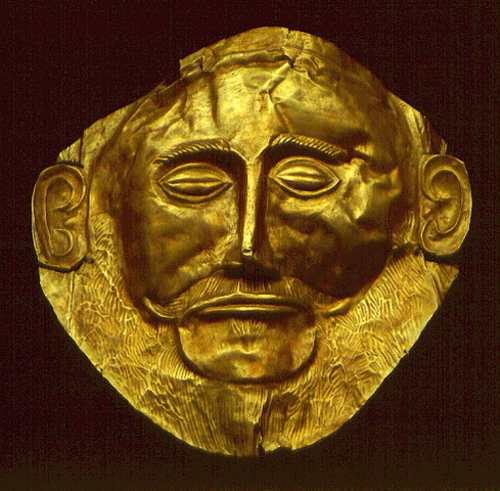
The latest is from the Philly Fed. Fed President and Open Market Committee member Anthony Santomero has announced his resignation after only a brief year and a half tenure. Very unusual. Hey, Fed Presidents are treated like gods. They have enormous power, prestige, and presence. Why quit? He is far from alone. Over the past few years no less than six Federal Reserve Regional Bank Presidents have resigned. This is highly unusual. An immediate impact is that we are about to have a largely inexperienced batch of individuals conducting monetary policy in the United States. So of course, the first thing they will do is hide the key money figures. Two positions for the Board of Governors (there are 7)have been open for quite a while. Plus six of the 12 Regional Head spots have turned over during the past few years. If a substantial amount of oil transactions will suddenly be conducted in Euros instead of Dollars, this should put pressure on the Dollar as folks exchange Dollars for Euros, jeopardizing the Dollar's status as the world's reserve currency, making it more difficult to print all the dollars the Fed wants to without driving the Dollar into the ground. Iraq threatened to do what Iran has threatened to do just before we went in looking for weapons of mass disappearance. If the Dollar tanks, Treasuries might not be far behind. If Treasuries tank, kiss the Housing-driven boom goodbye. Could the Master Planners be hiding M-3 because they anticipate they may have to monetize the Federal debt, buy our own Treasury Bonds during the coming economic attack against the Dollar? That would require a ton of new fresh money creation - too much to disclose. Could it be some folks at the top of the Fed do not have the stomach to be part of what is about to go down? M-3 has a direct but lagging impact on financial markets. Look at the chart at the top of the prior page. Whenever M-3 rises, the Dow Industrials rise. Whenever M-3 is flat or declines, the Dow Industrials decline. The Dow Industrials are a bellwether for the economy. If we can monitor M-3, we can better monitor the future path of equities and the economy. It is wrong for the Fed to stop its disclosure for this very reason. Investors need to know in a free market economy, because M-3 infusion is centrally planned intervention into a free market system. Investors need to know when the Master Planners have decided to intervene. Our buy/sell signals were designed to pick up the scent of Master Planner intervention by analyzing supply and demand forces underlying the markets. So with or without a fully disclosed M-3, we will be able to continue to identify coming multi-week trends. So what about M-3 the past week? The latest figures show that on a seasonally adjusted basis, M-3 rose 27.3 billion last week, a 14.0 percent annualized clip, and is up $76 billion over the past month, a 9.8 percent growth rate. But those are the massaged numbers. For the raw figures, fasten your seat belt. Are you ready? M-3 was increased $58.7 billion last week (that does not include the huge Repo infusions noted above), a 30.0 percent annualized rate of growth. For the past two week, the Fed added $93.5 billion to the money supply, a 24.0 percent annual clip. Over the past 6 weeks it is up $192.9 billion, a 16.7 percent Banana Republic hyperinflationary pace. This is nuts, folks - unless there is an incredible risk out there we are not being told about. That is a lot of money for the Plunge Protection Team's arsenal to buy markets - stocks, bonds, currencies, whatever. This level of irresponsible money supply growth makes shorting markets hazardous, yet at the same time says markets are at huge risk of declining. Maybe M-3 growth doesn't stop the decline this time. Should be a fascinating storm in 2006. The recent rise in Gold catalogued 74 points over about a month, a 16 percent rally from precisely the day the Fed announced it would hide M-3 from taxpayers and citizens of this great nation. That is no coincidence. Gold sees hyperinflation, monetization of debt, and intervention into free markets. Gold is telling us it expects Ben Bernanke to be an inflationist. |
Le Metropole Members,
GOLD UP $5 IN
TOKYO - MIDAS TECHNICAL ALERT
The Feb Comex
gold contract, which is the nearby pivotal one now on the
continuation charts, has taken out its high of 1981 of
$535 on a quarterly basis. This breakthrough is of big
picture importance. What is of note is the next
significant resistance for gold on a quarterly basis on
the continuation charts is all the way up to $612.
Frank Veneroso confirmed tonight what MIDAS and
GATA have been saying for some time. The Gold Cartel has
lost control of the gold market. This was also confirmed
to us the other day by one of the members who sat on the
Board of one of the 12 Fed banks. This Board member has
loaded his own boat (big numbers) with physical gold and
expects the price to reach $900 to $1,000 within 3 years.
This, from a conservative banker.
One of the most critical dynamics of the gold
market at the moment confirms what GATA has said all
along ... and what no one in the gold mainstream gold
world will even admit exists. There is a MASSIVE Gold
Cartel short position, one they cannot get out of. The
bums are trapped. These white-collar thugs, who have
violated US anti-trust laws for so many years, have
cooked their own goose.
I sent the following today to Ted David of CNBC,
which is like dropping an email into a black hole, but we
(GATA ARMY) have to keep up the good ole college try. I
included the Russian/GR 21 stuff I have been pounding
away on for weeks ... and these notes (facts):
*Since Gold Rush 21 gold rose $95 - YET, the dollar
rose from 87 to 91 and oil fell from $68 to $60 per
barrel. Almost no one thought that possible a year ago.
The key to the gold market is surging physical market
buying overtaking the Gold Cartel's ability to suppress
the price.
*For years
GATA stated the price of gold could rally $100 and the
dollar do nothing as The Gold Cartel lost control of
their price rigging scheme. Few, if anyone else, thought
that possible. (It has done that.)
*The Central banks have less than half the gold
they say they have. Over the last decade they have
surreptitiously lent out this missing gold in order to
suppress the price. This calculation is based on studies
by three GATA consultants.
*One of the major factors in the gold market today
is the gold short position ... more than 10,000 tonnes in
a market with a 1500 tonne yearly supply/demand deficit
and only 2500 tonnes per year coming out of the mines.
The shorts are trapped. Cannot get out. There are
mega-derivatives tied to those shorts. GATA knows this
because of the Bank For International Settlement
derivatives numbers.
*A Gold derivatives neutron bomb will go off. Could
happen at any time.
*Price prediction: Adam Fleming, former Chairman of
Harmony Gold and now Chairman of Wits Gold, said at Gold
Rush 21 that he is looking for $3,000 to $5,000 per
ounce. I concur.
Le Patron
www.LeMetropoleCafe.com
December 17, 2005
The Grand Illusion
by Rob Kirby
Who hasn't read about the U.S. Federal Reserve's plan to discontinue reporting M3 money supply data? Well, in case you missed it, you can read about it here:
Discontinuance of M3
On March 23, 2006, the Board of Governors of the Federal Reserve System will cease publication of the M3 monetary aggregate. The Board will also cease publishing the following components: large-denomination time deposits, repurchase agreements (RPs), and Eurodollars. The Board will continue to publish institutional money market mutual funds as a memorandum item in this release.
Measures of large-denomination time deposits will continue to be published by the Board in the Flow of Funds Accounts (Z.1 release) on a quarterly basis and in the H.8 release on a weekly basis (for commercial banks).
Much has already been written about this announcement - made on Nov. 10, 2005 - most of it not particularly flattering toward the Fed.
What strikes me as being of
most odd about the press release above is that "The
Board" will also cease publishing the following
components part. You see folks,
large-denomination time deposits, repurchase agreements
[RP's], Eurodollars and the like are exactly where one
would expect to find the 'capture' of any large scale
monetization effort that the Fed would embark upon -
should the need occur.
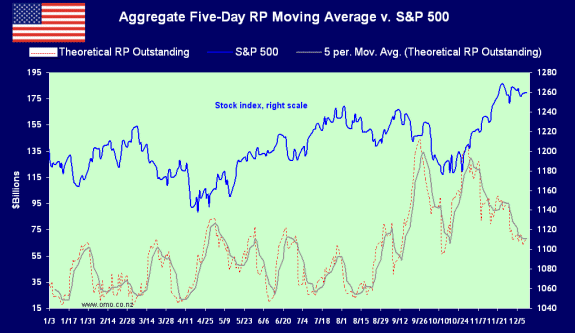
You see, I've written about this topic before and would like to remind everyone how the 'super spike' in aggregate outstanding Repos [Sept. 05] depicted in the chart below was directly co-related [time wise] to the well publicized liquidation [roughly 20 billion worth] of U.S. debt obligations by Venezuela.
Compliments:www.omo.co.nz
What strikes me as being even odder is the date - March
23, 2006 - that the Fed plans to cease reporting this
data. Any guesses as to what else [of major significance]
is supposed to happen on or about this date?
It just so happens that on March 20, 2006 - everybody's favorite Middle Eastern Nation, Iran - is scheduled to begin trading oil for Petroeuros on their own "newly minted" Iranian Oil Bourse [IOB].
So What You May Say?
Call me silly, but
has anyone noticed that the Fed's last report of M3 just
happens to be the week prior to the first day of trade on
the IOB? You see, if countries like Japan and China [and
other Asian countries] with their trillions of U.S.
dollars no longer need them [or require a great deal less
of them] to buy oil - does anyone suppose they might
begin a wholesale liquidation of their U.S. Bonds [the
primary instrument where foreigners 'store' their U.S.
dollars]?
Well, count me in coach - because [barring an accidental war or invasion of Iran] the demand for Petroeuros [and subsequent liquidation of dollars] could have - in Greenspan parlance - highly undesirable effects on foreigner's willingness to hold vast sums of U.S. debt obligations.
If [and I'm afraid when] foreigners begin wholesale liquidation of U.S. debt obligations, there is no doubt in my mind that the Fed will print the dollars necessary to redeem them - this would necessarily imply a an absolutely enormous [can you say hyperinflation] bloating of the money supply - which would undoubtedly be captured statistically in M3 or its related reporting.
It would appear that we're all going to be 'flying blind' as to how much money the Fed is truly going to pump into the system folks. My best guess is that the gold market [and perhaps the oil market, natural gas market, copper market, etc.] has already sensed this and is reacting accordingly. Better get your wheel barrows early, they might be harder to find than rocking horse droppings or M3 related statistics come April!
Gorillas, Rising
Gold Prices
and Depreciating Paper
Currencies!
Professor von Braun
The Rocket School of Economics
Dec 11, 2005
On March 2nd, 1933, the original King Kong movie opened in theaters in New York City. This preceded by 2 days Roosevelt’s inauguration as president on the 4th. On the 5th of March Hitler was given by his ‘new’ majority government, dictatorial powers over the German people. On March 6th the now President Roosevelt proclaimed a 3 day nationwide banking holiday, followed by the Emergency Banking Act on March 9.
On April 5, 1933 Roosevelt issued an executive order forbidding the hoarding of gold coin, gold bullion and gold certificates. Ownership of gold by an American citizen was now a Federal felony punishable by either a fine of $10000 or 10 years in prison. Interesting times!
Having confiscated the citizens (residents in the land of the free) gold holdings at $20.67 per ounce the price was slowly moved up (by perhaps the original cartel consisting of Jesse Jones, George Warren and Henry Morgenthau who met each morning at the presidents bed to set the gold price. Morgenthau became Treasury Secretary on January 1, 1934, a position he held until 1945. He was also the Chairman at the1944 Bretton Woods conference, which pegged all international currencies to the dollar which in turn was pegged to gold) until January 31, 1934 when the ‘official’ price was fixed at $35.00 per ounce, thereby reducing the actual gold content of the dollar by 40%. Private ownership of gold was not allowed again until Dec 31, 1974, three years and four months after Nixon in August 1971 took the US off the gold standard altogether. So much for Bretton Woods!
By this time gold was trading at $197.25 per ounce, up $176.58 from the pre March, 1933 level of $20.67. At that level the gold content of the dollar had reduced to approximately 11%. From that level the price of gold fell to a low of $103.05 in the fall, (September 1) of 1976, rallied back to $138 in mid November, declined to $121 in January of 1977 then rallied for three years peaking on January 21, 1980 at $850.
Coincidentally the first remake of the original 1933 movie King Kong was released in New York on Dec 16th, 1976.
Since the late 1600’s the price of gold has been determined by various central banks starting with the United Kingdom, ending with the US with 59 countries being on a gold or gold exchange standard at various times, China being the notable exception. After 1971 all bets were off when it came to a known amount of a central banks currency per ounce of gold, something the gold market had perhaps intuited when gold bottomed Jan 20, 1970 at $60.65. This was the beginnings of the rally that lasted through to December 1974.
This brings me to the history of gold bull markets, which is limited to say the least. Having free traded (sort of) for only a short period of 35 years, certainly short when compared to other markets and their ‘history’, bull markets in gold are perhaps a bit of a misnomer. Rising gold prices tend to occur when currencies whether intentionally or otherwise, begin to devalue, with gold being the barometer that reflects the devaluation.
Commodities of course came first and are the natural element of trade, paper being the man made ingredient that operates as an IOU. Just what IOU is another matter, but in the good old days gold was the preferred means of settlement. The gold coins of the Byzantine empire allowed trade to be conducted in relatively peaceful atmosphere for eight hundred years until some rather indebted emperor decided that to reduce his debts he could devalue the coins by reducing the gold content and pay with them instead. The Arab Dinar circulated for some 450 years during which the Arab culture flourished. What is a gold coin? It’s a known amount of a recognized commodity is what it is, one that was freely bartered for other commodities, without the interference of paper printing central bankers and with no doubt as to its value.
What Roosevelt did in 1934 was reduce the gold content of the dollar, which equates to how much gold you can redeem for a dollar. He went further than that by making gold ownership illegal altogether, a situation that remained in place for nearly 41 years. Yes it really was a new deal!
Was the rise in the price of gold from $20.67 to $35.00 the first bull market in gold? Or was the first bull market the one that began in 1970? Is the bull market in gold that began in either 1999 or 2001 the second or the third in the last 75 years? Or are they all the same thing, a reflection of a depreciating currency and a messed up banking system?
Monetary history is of course not something that the average pundit on CNBC knows anything about, in fact the term NO CLUE comes to mind when one listens to the latest comments about the recent rise in the gold price. Now we hear about fundamentals, supply and demand, debt levels, and inflationary pressures. What we don’t hear about is the ongoing fraud that fiat currencies are. Few it seems have figured out that having a balance sheet that’s carrying digits in the plus column does not represent holding a tangible profit. Rather it means that one is holding debt instruments that are not redeemable by the issuer for anything tangible. In that sense the ‘trade’, regardless of what it is, never gets completed.
Yes there is a fundamental problem with the gold market, yes there is a supply and demand problem and yes there is a problem with debt denominated instruments. At current price levels there is not enough gold to go round, supply has been decreasing and demand increasing and debt instruments have grown out of all proportion in relationship to their actuality of ever being repaid. The currency has depreciated itself over time by a very large degree as any currency must do if its not backed by something it can be redeemed for.
The rising gold price is a reflection of the awareness of that situation and talk about gold being seriously overbought at this point is ridiculous. With rising debt levels being about the only thing that keeps both internal and international trade afloat, with debt levels at a minimum,10 times greater that they were in 1980, (which were 20 times greater than they were in 1934) when gold was last at $850 per ounce, with literally several thousands of tons of gold being traded as paper contracts that have no hope of ever being fulfilled by way of delivery, with central bank gold leased out that can never be returned in total, the CNBC pundits, the cheerleaders of the fiat monetary system really have no idea and its beginning to show in the comments they are making, the questions they are asking and the slight hint of nervousness that is starting to appear.
The real question should be: ‘how far has the dramatic increase in debt levels affected the ongoing depreciation of the dollar and how far will the key depreciation indicator, gold, rise to reflect that situation?’
Currently with gold at $527.00 per ounce gold is at a 25.5 multiple of $20.67. Put another way $20.67 today will buy 1/25th of an ounce of gold at today’s prices. However there are a lot more dollars and debt instruments in circulation in 2005 than there was in 1933. The supply of newly mined gold available for purchase has not increased at the same rate as the debt creation scheme and central bank gold holdings, the key ingredient to price manipulation have also, in most cases, decreased.
The rising price of commodities should be giving the fiat cheerleaders a clue about what’s in store for gold, as should the rather obvious fact that the price of gold in all currencies has been rising since 1999, which should not be surprising since they are all fiat currencies.
The second remake of the 1933 classic movie King Kong is scheduled for release in New York on December 14th, 2005.
It may well be that its devaluation time again!
Von Braun can be contacted by email at profvonb2@aol.com.
Is
central bank independence all it's cracked up to be?
As Alan Greenspan departs, he leaves behind a heavily
burdened US economy that is already contributing to
global financial instability
By Joseph Stiglitz
http://www.taipeitimes.com/News/editorials/archives/2005/11/15/2003280259
Tuesday, Nov 15, 2005,Page 9
Alan Greenspan attained an almost iconic status as
governor of the US Federal Reserve Board. So, as his term
draws to a close and his mantle of infallibility is
passed on to his successor, it is worth examining whether
his legacy will measure up and what we can expect from
the new Fed chief, Ben Bernanke.
Few central bank governors have the kind of hagiography
lavished upon them, especially in their lifetime, that
Greenspan has had. But what makes for a great central
bank governor in our modern societies: great institutions
or great individuals?
In economics, we seldom have a clearly defined
counterfactual: Would the economy have performed even
better or a little differently if someone else had been
at the helm? We can't know, but there is little doubt
that those "managing" the economy receive more
credit than they deserve, if sometimes less blame.
Many forces behind the boom of the 1990s, including
advances in technology, were set in motion before former
US president Bill Clinton took office (just as the legacy
of President George W. Bush's deficits will be felt long
after he leaves). So Greenspan cannot be given credit for
the boom.
But, while no central bank governor can ensure economic
prosperity, mismanagement can cause enormous harm. Many
of the US' post-World War II recessions were caused by
the Fed hiking interest rates too fast and too far.
There is little doubt that Greenspan had great moments,
when one could at least imagine a less deft governor
doing the "wrong" thing with disastrous
consequences. One such moment was the stock market crash
of 1987. Perhaps another occurred in 1998, when the Fed
lowered interest rates in the face of what appeared to be
an impending global financial crisis.
These successes, combined with the 1990s boom and the
seeming durability of price stability, reinforced
Greenspan's exalted status. But they also led many to
forget less successful moments.
The Fed failed to avert the economic downturn of 1990,
and a reading of Greenspan's testimony to Congress during
that period makes clear that the basic nature of the
economy's problems was not well understood.
But the real problem for Greenspan's legacy concerns what
happened to the US economy in the last five years, for
which he bears heavy responsibility. Greenspan supported
the tax cuts of 2001 with the most specious of arguments
-- that unless something was done about the US' soaring
fiscal surpluses, the national debt would be totally paid
off within, say, 10 to 15 years.
According to Greenspan, immediate action needed to be
taken to avert this looming disaster, which would impede
the Fed's ability to conduct monetary policy.
It says a great deal about the gullibility of financial
markets that they took this argument seriously. More
accurately, tax cuts were what Wall Street wanted, and
financial professionals were willing to accept any
argument that served that purpose.
Of course, if, say, by 2008 the disappearing national
debt really did appear to pose an imminent danger,
Congress would have happily obliged in cutting taxes or
increasing expenditures.
Greenspan's irresponsible support of that tax cut was
critical to its passage. The fault was not only in the
magnitude of the tax cut, but also in its design; by
directing the cuts at upper-income Americans, it provided
little economic stimulus.
But soaring deficits did not return the economy to full
employment, so the Fed did what it had to do -- cut
interest rates. Lower interest rates worked, not so much
because they boosted investment, but because they led
households to refinance their mortgages, and fueled a
bubble in housing prices.
In short, as Greenspan departs, he leaves behind a US
economy burdened with high household and government debt
and fragile balance sheets -- a legacy that is already
contributing to global financial instability.
It is still not clear what led Greenspan to support the
tax cut. Was it a massive economic misjudgment, or was he
currying favor with the Bush administration? The most
likely explanation is a combination of the two, for he
and Bush were pursuing the same "starve the
beast" political strategy, which calls for tax cuts
to be used to reduce revenues, thereby forcing the public
sector to be downsized.
The traditional argument for an independent central bank
is that politicians can't be trusted to conduct monetary
and macroeconomic policy. Neither, evidently, can central
bank governors, at least when they opine in areas outside
their immediate responsibility.
Greenspan was as enthusiastic for a policy that led to
soaring deficits as any politician; but the fig leaf of
being "above politics" gave credence to that
policy, engendering support from some who otherwise would
have questioned its economic wisdom.
This, then, is Greenspan's second legacy -- growing doubt
about central bank independence.
Macroeconomic policy can never be devoid of politics: It
involves fundamental trade-offs and affects different
groups differently. Unemployment harms workers, while the
lower interest rates needed to generate more jobs may
lead to higher inflation, which especially harms those
with nominal assets whose value is eroded.
Such fundamental issues cannot be relegated to
technocrats, particularly when those technocrats place
the interests of one segment of society above others.
Indeed, Greenspan's political stances were so thinly
disguised as professional wisdom that his tenure exposed
the dubiousness of the very notion! of an independent
central bank and a non-partisan central banker.
Unfortunately, many countries have committed themselves
to precisely this illusion, and it may be a long time
before they take heed of Greenspan's most important
lesson. Stressing the new Fed chief's
"professionalism" may only delay the moment
when this lesson is learned again.
Joseph Stiglitz is professor of economics at Columbia
University.