JANUARY 2006
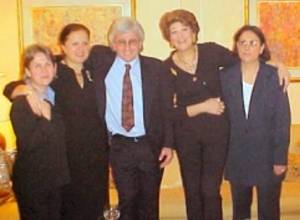
Deir Yassin Day Committee members Liz Rolfs, Janet
St. John-Austen, Paul Eisen and Muna Nashashibi with
Amina Nasrallah.
Jewish Power
By
Paul Eisen - (August 19, 2004)
The crime against the Palestinian people is being
committed by a Jewish state with Jewish soldiers using
weapons displaying Jewish religious symbols, and with the
full support and complicity of the overwhelming mass of
organised Jews worldwide. But to name Jews as responsible
for this crime seems impossible to do.
The future is always open and nothing can ever be ruled
out; but, for now, it's hard to see how Israel can be
stopped. After over fifty years, it is clear that Israel
will only relinquish its eliminationist attitude to
Palestinians and Palestinian life when it has to. This
need not be through military action but it is hard to see
how anything else will do. The conventional wisdom - that
if America turned off the tap, Israel would be brought to
its knees - is far from proven. First, it's not going to
happen. Second, those who believe it may well be
underestimating both the cohesiveness of Israeli society
and the force of Jewish history which permeates it. Even
more unlikely is the military option. The only force on
earth which could possibly confront Israel is the
American military, and, again, that is not going to
happen.

Palestinian resistance has been astonishing. After over
fifty years of brutal assault by what may well one day be
seen as one of the most ruthless and irrational powers of
modern times, and with just about every power on earth
ranged against them, Palestinians are still with us,
still steadfast, still knowing who they are and where
they come from. Nonetheless, for the time being effective
resistance may be over (though the possibility of
organised non-violent resistance can never be ruled out),
and, for now, the only strategy open may be no more than
one for survival.
For us it is so much easier to deny this reality than to
accept it, and doubtless the struggle will continue. How
fruitful this will be no-one can say. Although the
present seems hopeless, survival is still vital and
no-one knows when new opportunities may arise. Anyway, to
struggle against injustice is always worth doing. But
what if the struggle becomes so delusional that it
inhibits rather than advances resistance? What if the
struggle becomes a way of avoiding rather than
confronting reality? Those slogans "End the
Occupation!" and "Two States for Two
Peoples!" are now joined by a new slogan, "The
One-State Solution!" This is every bit as fantastic
as its predecessors because, just as there never was
going to be an end to the occupation, nor a real
Palestinian state, so, for now, there is no possibility
of any "one state" other than the state of
Israel which now stretches from the Mediterranean Sea to
the Jordan River, and the only "solution" is a
final solution and even that cannot be ruled out.
"Zionism
is not Judaism;
Judaism is not Zionism…."
The crime against the Palestinian people is being
committed by a Jewish state with Jewish soldiers using
weapons with Jewish religious symbols all over them, and
with the full support and complicity of the overwhelming
mass of organised Jews worldwide. But to name Jews as
responsible for this crime seems impossible to do. The
past is just too terrible. All of us know of the hatred
and violence to which accusations against Jews have led
in the past. Also, if we were to examine critically the
role of Jews in this conflict, what would become of us
and of our struggle? Would we be labelled anti-Semites
and lose much of the support that we have worked so hard
to gain?
The present, too, is full of ambiguities. Zionism is
not Judaism; Judaism is not Zionism has become an
article of faith, endlessly repeated, as is the assertion
that Zionism is a secular ideology opposed, for much of
its history, by the bulk of religious Jews and even now
still opposed by true Torah Jews such as Neturei Karta.
But Zionism is now at the heart of Jewish life with
religious Jews amongst the most virulent of Zionists and
Neturei Karta, despite their impeccable anti-Zionism,
their beautiful words and the enthusiasm with which they
are welcomed at solidarity rallies, etc., may well be
just Jews in fancy dress, a million miles from the
reality of Jewish life.
And even if Zionism can still be disentangled from
Judaism, can it be distinguished from a broader Jewish
identity or Jewishness? So often Zionism is
proclaimed to be a modern add-on to Jewish identity,
another, albeit anachronistic, settler-colonial ideology
simply adopted by Jews in response to their predicament.
But, could it be that our need to avoid the accusation of
anti-Semitism and our own conflicted perceptions and
feelings, our insistence that Zionism and Jewishness are
separate, has led us seriously to misunderstand the
situation? Has our refusal to look squarely at the very Jewishness
of Zionism and its crimes caused us to fail to understand
exactly what we are up against?
Jews, Judaism and Zionism
Jews are complex; Jewish identity is complex and the
relationship between Judaism the religion, and a broader,
often secular, Jewish identity or Jewishness is very
complex indeed. Jewishness may be experienced a long way
from synagogue, yeshiva or any other formal
aspect of Jewish religious life, yet is often still
inextricably bound to Judaism. That is why secular Jews
are able to proclaim their secularity every bit as loudly
as they proclaim their Jewishness. Marc Ellis, a
religious Jew, says that when you look at those Jews who
are in solidarity with Palestinians, the overwhelming
majority of them are secular - but, from a religious
point of view, the Covenant is with them. For
Ellis, these secular Jews unknowingly and even
unwillingly may be carrying with them the future of
Jewish life.
Jewish identity, connecting Jews to other Jews, comes
from deep within Jewish history. This is a shared
history, both real and imagined, in that it is both
literal and theological. Many Jews in the west share a
real history of living together as a distinct people in
Eastern, Central and then Western Europe and America.
Others share a real history of settlement in Spain
followed by expulsion and then settlement all over the
world, particularly in Arab and Islamic lands. But this
may not be what binds all Jews, because for all
Jews it is not a real, but maybe a theological, history
that is shared. Most Palestinians today probably have
more Hebrew blood in their little fingers then most
western Jews have in their whole bodies. And yet, the
story of the Exodus from Egypt is as real to many of
them, and most importantly was as real to them when they
were children, as if they, along with all Jews, had stood
with Moses at the foot of Mount Sinai.
And histories like that don't stop at the present. Even
for secular Jews, though unacknowledged and even
unrealized, there is a sense, not only of a shared
history, but also of a shared destiny. Central to Jewish
identity both religious and non-religious is the sense of
mission centered on exile and return. How else to explain
the extraordinary devotion of so many Jews, religious and
secular, to the "return" to a land with which,
in real terms, they have very little connection at all?
For many Jews, this history confers a 'specialness'. This
is not unique to Jews - after all, who in their heart of
hearts does not feel a little bit special? But for Jews
this specialness is at the centre of their
self-identification and much of the world seems to
concur. For religious Jews, the specialness comes from
the supposed covenant with God. But for secular Jews, the
specialness comes from a special history. In either case
this can be a good, even a beautiful, thing. In much of
Jewish religious tradition this specialness is no more
than a special moral obligation, a special responsibility
to offer an example to the world, and for so many secular
Jews it has led them to struggle for justice in many
places around the world.
At the heart of this Jewish specialness is Jewish
suffering and victimhood. Like the shared history itself,
this suffering may, but need not, correspond to reality.
Jews have certainly suffered but their suffering remains
unexamined and unexplained. The Holocaust, now the
paradigm of Jewish suffering, has long ceased to be a
piece of history, and is now treated by religious and
secular alike, as a piece of theology - a sacred text
almost - and therefore beyond scrutiny. And the suffering
never ends. No matter how much Jews have suffered they
are certainly not suffering now, but for many Jews their
history of suffering is not just an unchallengeable past
but also a possible future. So, no matter how safe Jews
may be, many feel just a hair's-breadth away from
Auschwitz.
Zionism is at the heart of this. Zionism is also complex
and also comes from deep within Jewish history with the
same sense of exile and return. Zionism also confirms
that Jews are special in their suffering and is explicit
that Jews should 'return' to a land given to them, and
only them - by God if they are religious, or by history
if they are not - because they simply are not safe
anywhere else on earth.
But so what? If Jews think that they are a people with a
religious link to a land and have a deep wish to
'return', why should we care, so long as the land is not
already populated by Palestinians? And if Jews feel that
they are special and that God has made some kind of
special arrangement with them, so what, so long as this
does not lead them to demand preferential treatment and
to discriminate against others? And if Jews feel that
they have suffered like no-one else on the face of the
earth, fine, so long as they do not use this suffering to
justify the imposition of suffering on others and to
blackmail morally the whole world into quiescent silence.
This is the problem with Zionism. It expresses Jewish
identity but also empowers it. It tells Jews (and many
others too) that Jews can do what Jews have always
dreamed of doing. It takes the perfectly acceptable
religious feelings of Jews, or if you prefer, the
perfectly harmless delusions of Jews, and tries to turn
them into a terrible reality. Jewish notions of
specialness, choseness and even supremacism, are fine for
a small, wandering people, but, when empowered with a
state, an army and F16s become a concern for us all.
Zionism as Jewish empowerment in statehood changes
everything. Israel is not just any state, it is a Jewish
state and this means more than just a state for Jews.
This Jewish state is built on traditions and modes of
thought that have evolved amongst Jews for centuries -
amongst which are the notions that Jews are special and
that their suffering is special. By their own reckoning,
Jews are "a nation that dwells alone" it is
"us and them" and, in many cases, "us or
them". And these tendencies are translated into the
modern state of Israel. This is a state that knows no
boundaries. It is a state that both believes, and uses as
justification for its own aggression, the notion that its
very survival is always at stake, so anything is
justified to ensure that survival. Israel is a state that
manifestly believes that the rules of both law and
humanity, applicable to all other states, do not apply to
it.
Their own worst nightmare
It is a terrible irony that this empowerment of Jews has
come to most resemble those empowerments under which Jews
have suffered the most. Empowered Christianity, also a
marriage of faith and power, enforced its ideology and
pursued its dissidents and enemies with no greater fervor
than has empowered Judaism. In its zeal and self belief,
Zionism has come to resemble the most brutal and
relentless of modern ideologies. But unlike the brutal
rationality of Stalinism, willing to sacrifice millions
for political and economic revolution, this Jewish
ideology, in its zealotry and irrationality, resembles
more the National Socialism which condemned millions for
the attainment of a nonsensical racial and ethnic
supremacy.
Of course there are differences but there are also
similarities. National Socialism, like Zionism, another
blend of mysticism and power, gained credibility as a
means to right wrongs done to a victimized people.
National Socialism, like Zionism, also sought to maintain
the racial/ethnic purity of one group and to maintain the
rights of that ethnic group over others, and National
Socialism, like Zionism, also proposed an almost mystical
attachment of that group to a land. Also, both National
Socialism and Zionism shared a common interest - to
separate Jews from non-Jews, in this case to remove Jews
from Europe - and actively co-operated in the attainment
of this aim. And if the similarity between these two
ideologies is simply too great and too bitter to accept,
one may ask what National Socialism with its uniforms,
flags and mobilized youth must have looked like to those
Germans, desperate after Versailles and the ravages of
post-First World War Germany. Perhaps not so different
from how the uniforms, flags and marching youth of pre-
and post-state Zionism must have looked to Jews after
their history of suffering, and particularly after the
Holocaust.
This is, for Jews, their own worst nightmare: the thing
they love the most has become the thing they hate the
most. And for those Jews and others, who shrink from the
comparison, let them ask themselves this: What would an
average German, an enthusiastic Nazi even, have said in,
say, 1938 had they been confronted with the possibility
of an Auschwitz? They would have thought that you were
stark, staring mad.
American
Jews and Jewish America
At the heart of the conflict is the relationship between
Israel and America. The statistics - billions in aid and
loans, UN vetoes, etc., etc. need not be repeated here -
American support for Israel seems limitless. But what is
the nature of this support? For many, perhaps most, the
answer is relatively simple. Israel is a client state of
America, serving American interests or, more
particularly, the interests of its power elites. This
view is underpinned by the obvious importance of oil, the
huge strategic importance of the region and the fact
that, if Israel did not further the interests of those
who control America, then we can be sure America would
not support Israel. Also, there is no doubt that, in the
IDF, America has found a marvellously flexible and
effective force, easily aroused and let loose whenever
any group of Arabs get a little above themselves.
But is this the whole story? Does Israel really serve
America's interests and is their relationship wholly
based on the sharing of these interests? Consider how
much in terms of goodwill from other nations America
loses by its support for Israel, and consider the power
and influence of the "Jewish",
"Zionist" or "pro-Israel" lobby, as
when many an otherwise responsible lawmaker, faced with
the prospect of an intervention in their re-election
campaign from the Jewish lobby, seems happy to put his or
her re-election prospects way in front of what is good
for America.
The details of the workings of AIPAC and others, and the
mechanics by which these groups exert pressure on
America's lawmakers and governors, have been dealt with
elsewhere; we need only note that this interest group is
undoubtedly extraordinarily effective and successful. Not
just a small group of Jews supporting Israel, as its
supporters would have us believe, these are powerful and
committed ideologues: billionaires, media magnates,
politicians, activists and religious leaders. In any
event, the power of the Jewish lobby to make or break
pretty well any public figure is legendary - not for
nothing is it often referred to simply as "The
Lobby".
But again, there may be far more to the Israel/U.S.
relationship than just a commonality of interest and the
effectiveness of certain interest groups. That support
for Israel must be in the interests of those who control
America is certainly true, but who controls America?
Perhaps the real relationship is not between Israel and
America but between Jews and America.
The overwhelming majority of Jews in America live their
lives just like any other Americans. They've done well
and are undoubtedly pleased that America supports their
fellow Jews in Israel but that's as far as it goes.
Nonetheless, an awful lot of Jews certainly do control an
awful lot of America - not the industrial muscle of
America - the steel, transport, etc., nor the oil and
arms industries, those traditional money-spinners. No, if
Jews have influence anywhere in America, it's not over
its muscle and sinew but over its blood and its brain. It
is in finance and the media that we find a great many
Jews in very influential positions. Lists abound (though
you have to go to some pretty unpopular websites to find
them) of Jews, prominent in financial and cultural life:
Jews in banks; Jews in Forbes Magazine's Richest
Americans; Jews in Hollywood; Jews in TV; Jewish
journalists, writers, critics, etc., etc.
Nor have Jews been slow in exploiting their position.
Jews have not hesitated to use whatever resources they
have to advance their interests as they see them. Nor
does one need to subscribe to any conspiracy theory to
note how natural it is for Jews in the media to promote
Jews and their values as positive and worthy of
emulation. When did anyone last see a Jew portrayed in
anything other than a favourable light? Jews are clever,
moral, interesting, intense, warm, witty, complex,
ethical, contradictory, prophetic, infuriating, sometimes
irritating, but always utterly engaging. Nor is it any
wonder that Jews in influential positions are inclined to
promote what they see as Jewish collective interests. Is
it really all that incredible that Jewish advisers around
the Presidency bear Israel's interests at heart when they
advise the President on foreign affairs?
But so what? So there are a lot of Jews with a lot of
money, and a lot of Jews with a lot to say and the means
to say it. If Jews by virtue of their ability and use of
resources (as honestly gained as by anyone else) promote
what they perceive as their own collective interest,
what's wrong with that? First, with some notable
exceptions, the vast majority of Jews can, in good faith,
lay hands on hearts and swear that they never take
decisions or actions with collective Jewish interests in
mind, certainly not consciously. And even if they did,
they are acting no differently from anyone else. With a
few exceptions, Jews have earned their advantageous
positions. They came with nothing, played according to
the rules and, if they use their influence to further
what they perceive as Jewish interests, what's so special
about that? Do not the Poles, the Ukrainians, the Gun
lobby, the Christian Evangelicals also not work to
further their group interests?
The difference between Jews and other groups is that they
probably do it better. Jews are, by pretty well any
criteria, easily the most successful ethnic group in
America and, for whatever reason, have been
extraordinarily successful in promoting themselves both
individually and collectively. And there would probably
be nothing wrong with this were it not for the fact that
these same people who exert so much control and influence
over American life also seem to refuse to be held
accountable. It is the surreptitiousness with which Jews
are perceived to have achieved their success which
arouses suspicion. Jews certainly seem cagey about the
influence they have. Just breathe the words "Jewish
power" and wait for the reaction. They claim it's
because this charge has so often been used as a precursor
to discrimination and violence against them, but never
consider the possibility that their own reluctance to
discuss the power they wield arouses suspicion and even
hostility.
But there is another claim, subtler and more worrying.
This is that it doesn't exist; that Jews do not
wield power, that there is no Jewish lobby; that Jews in
America do not exert power and influence to advance
Jewish interests, even that there are no such things
as Jewish interests! There are no Jewish interests
in the war in Iraq, there are no Jewish interests in
America; most amazing, there are no Jewish interests even
in Israel and Palestine. There is no Jewish collective.
Jews do not act together to advance their aims. They even
say that the pro-Israeli lobby has actually not all that
much to do with Jews, that the Jewishness of Israel is
irrelevant and the Public Affairs Committees (PACs) which
lobby so hard for Israel are in fact doing no more than
supporting an ally and thus looking after America's best
interests even to the extent of concealing their true
purpose behind names such as "American for Better
Citizenship", "Citizen's Organised PAC" or
the "National PAC" - none of which make one
reference in their titles to Israel, Zionism or Jews.
Similarly, Jews and Jewish organisations are said to be
not so much furthering Jewish interests and values as
American, or, even, universal interests and values. So,
the major Holocaust Museum, styled as a "Museum of
Tolerance", focuses not only on anti-Semitism, but
on every kind of intolerance known to mankind (except
that shown by Jews to non-Jews in Israel and Palestine).
Similarly, the Anti-Defamation League is but an
organisation for the promotion of universal principles of
tolerance and justice, not just for Jews but for
everyone.
This conflation of Jewish interests with American
interests is nowhere more stark than in present American
foreign policy. If ever an image was reminiscent of a
Jewish world conspiracy, the spectacle of the Jewish
neo-cons gathered around the current presidency and
directing policy in the Middle East, this must be it. But
we are told that the fact that the Jewish neo-cons, many
with links with right wing political groups within
Israel, are in the forefront of urging a pro-Israel
policy, is but a coincidence, and any suggestion that
these figures might be influenced by their Jewishness and
their links with Israel is immediately marginalised as
reviving old anti-Semitic myths about Jewish dual
loyalty. The idea that American intervention in Iraq, the
one viable military counterweight to Israeli hegemony in
the Middle East and therefore an inspiration to Arab and
Palestinian resistance, primarily serves Israeli rather
than American interests has also been consigned to the
nether world of mediaeval anti-Semitic myth. The
suggestion that those Jews around the president act from
motives other than those to promote the interests of all
Americans is just anti-Semitic raving. And maybe they're
right. Perhaps those who promote Jewish interests are in
fact promoting American interests because, for now at
least, they appear to be one and the same.
Jewish America
In Washington, D.C. is a memorial to a terrible tragedy.
Not a memorial to a tragedy visited on Americans by a
foreign power as at Pearl Harbour or 9/11, nor to a
tragedy visited by Americans on Americans such the
sacking of Atlanta. Nor is it a memorial of contrition to
a tragedy inflicted by Americans onto another people,
such as to slavery or to the history of racial injustice
in America. It is to none of these. The Holocaust
memorial is to a tragedy inflicted on people who
were not Americans, by people who were not
Americans, and in a place a very long
way from America. And the co-religionists or, even, if
you like, the co-nationals, of the people on whom the
tragedy was visited and to whom the memorial is built
make up around two percent of the American population.
How is it that a group of people who make up such a tiny
percentage of the overall American population can command
such respect and regard that a memorial to them is built
in the symbolic heart of American national life?
The Jewish narrative is now at the centre of American
life, certainly that of its cultural and political
elites. There is, anyway, much in the way that Americans
choose to see themselves and their history which is quite
naturally compatible with the way Jews see themselves and
their history. What more fitting paradigm for a country
founded on immigration, than the story of the mass
immigration of Jews at the end of the nineteenth and
early twentieth centuries? For many Americans, the story
of those Jews who came to their Goldenes Medina, their
Golden Land, with nothing and, through hard work and
perseverance, made it to the very top of American
society, is also their story. And what could be more
inspirational for a country, if not officially but still
viscerally, deeply Christian than the story of the Jews,
Jesus' own people and God's chosen people, returning to
their ancient homeland and transforming it into a modern
state. And for a nation which sees itself as a beacon of
democracy in the world, what better international
soul-mate than the state of Israel, widely held to be
"the only democracy in the Middle-East"?
Finally what greater validation for a country itself
founded on a narrative of conquest and ethnic cleansing
than the Biblical narrative of the conquest and ethnic
cleansing of the Promised Land with the addition of the
equally violent settlement of modern Palestine with its
own ethnic cleansing and then "making the desert
bloom"?
Most resonant, of course, is the notion of Jews as a
suffering people. The fact that this "suffering
people" is now enjoying a success beyond the dreams
of any other ethnic group in America seems irrelevant.
Also ignored is how American Jews have made it to the
very top of American society whilst, every step of the
way, complaining about how much they're being
discriminated against. Nonetheless, to America, Jews have
an enduring and ongoing history of suffering and
victimhood. But this history has rarely been examined or
even discussed.
A Suffering People
That Jews have suffered is undeniable, but Jewish
suffering is claimed to have been so enduring, so intense
and so particular that it is to be treated differently
from other sufferings. The issue is complex and cannot be
fully debated or decided here but the following points
may stimulate thought and discussion.
- During
even the most terrible times of Jewish suffering
such as the Crusades or the Chmielnitzky
massacres of seventeenth century Ukraine, and
even more so at other times in history, it has
been said that the average peasant would have
given his eye-teeth to be a Jew. The meaning is
clear: generally speaking, and throughout most of
their history, the condition of Jews was often
far superior to the mass of the population.
- The
above-mentioned Ukrainian massacres took place in
the context of a peasant uprising against the
oppression of the Ukrainian peasantry by their
Polish overlords. As has often been the case,
Jews were seen as occupying a traditional
position of being in alliance with the ruling
class in their oppression of the peasantry.
Chmielnitzky, the leader of this popular
uprising, is today a Ukrainian national hero, not
for his assaults on Jews (there are even
references to his having offered poor Jews to
join the uprising against their exploitative
co-religionists - the Jews declined) but for his
championing of the rights of the oppressed
Ukrainians. Again, the inference is plain:
outbreaks of anti-Semitic violence, though never
justified, have often been responses to Jewish
behaviour both real and imaginary.
- In the Holocaust three million Polish Jews died, but so did three million non-Jewish Poles. Jews were targeted but so were Gypsies, homosexuals, Slavs and Poles. Similarly, the Church burned Jews for their dissenting beliefs but then the church burned everyone for their dissenting beliefs. So again, the question must be asked: what's so special about Jewish suffering?
The Holocaust, the
paradigm for all anti-Semitism and all Jewish suffering,
is treated as being beyond examination and scrutiny.
Questioning the Holocaust narrative is, at best, socially
unacceptable, leading often to social exclusion and
discrimination, and, at worst, in some places is illegal
and subject to severe penalty. Holocaust revisionist
scholars, named Holocaust deniers by their opponents,
have challenged this. They do not deny a brutal and
extensive assault on Jews by the Nazi regime but they do
deny the Holocaust narrative as framed by present day
establishments and elites. Specifically, their denial is
limited to three main areas. First, they deny that there
ever was an official plan on the part of Hitler or any
other part of the Nazi regime systematically and
physically to eliminate every Jew in Europe; second, they
deny that there ever existed homicidal gas-chambers;
third, they claim that the numbers of Jewish victims of
the Nazi assault have been greatly exaggerated.
But none of this is the point. Whether those who question
the Holocaust narrative are revisionist scholars striving
to find the truth and shamelessly persecuted for opposing
a powerful faction, or whether they are crazy Jew-haters
denying a tragedy and defaming its victims, the fact is
that one may question the Armenian genocide, one may
freely discuss the Slave Trade, one can say that the
murder of millions of Ibos, Kampucheans and Rwandans
never took place and that the moon is but a piece of
green cheese floating in space, but one may not question
the Jewish Holocaust. Why? Because, like the rest of the
Jewish history of suffering, the Holocaust underpins the
narrative of Jewish innocence which is used to bewilder
and befuddle any attempt to see and to comprehend Jewish
power and responsibility in Israel/Palestine and
elsewhere in the world.
Jewish
Power
What is a Jew?
Israel Shamir, the Russian-born Israeli writer, advocates
the right of all people, whatever their ethnicity or
religion, to live together in complete equality between
the Mediterranean and the Jordan River. Shamir condemns
the behaviour of Israel and of Diaspora Jews and calls
for an end to their preferential treatment, but he also
proposes an opposition to Judaism itself for which he
stands accused of being anti-Jewish - a charge he does
not deny but actually embraces.
Shamir proposes the existence of a Jewish ideology, or
"Jewish paradigm" as he puts it, and proposes
that it is the voluntary adherence to this
"spirit" which makes a Jew into a Jew. For him,
Jewishness is neither race nor ethnicity - there is, for
Shamir, no such thing as a Jewish 'tribe' or 'family' -
no biological or ethnic body from which there can be no
escape. Further, this ideology, based on notions of
choseness, exclusivity and even supremacism is, at least
when empowered, incompatible with peace, equality and
justice in Palestine or anywhere else for that matter.
No-one wants to oppose any Jews simply for being Jews, or
even for what they believe, but only because of what they
do. The problem is that since, according to Shamir, what
Jews believe and even do is precisely what makes them
into Jews, so opposition to Jewishness as an ideology
surely comes dangerously close to opposition to Jews
simply for being Jews. But for Shamir, Jews are Jews
because they choose to be Jews. Someone may be born of
Jews and raised as a Jew but they can if they wish reject
their Jewish upbringing and become a non-Jew. And many
have done just that including such famous escapees as
Karl Marx, St. Paul, Leon Trotsky (and Shamir himself),
etc. Opposition to Jews is not, therefore, like
opposition to Blacks or to Asians or to other common
racist attitudes since the object of the opposition is
perfectly able to relinquish the ideology in question.
Shamir has never in any way called for any harm to be
done to Jews or anyone else, nor for Jews or anyone else
to be discriminated against in any way. Adherence to this
Jewish ideology is, for Shamir, regrettable, but not, in
itself, a matter for active opposition. Nor does this
mean that Shamir is opposed to any individual Jew just
because he or she is a Jew. What Shamir actively opposes
is not "Jews" but "Jewry". Analogous
to say, the Catholic Church, Jewry consists of those
organised Jews and their leaders who actively promote
corrosive Jewish interests and values, particularly now
in the oppression of the Palestinians.
One doesn't have to be in complete agreement with Shamir
to understand what he is talking about. Why should Jews
not have a "spirit"; after all, such a concept
has been discussed with regard to other nations?
"It
is dangerous, wrong, to speak about the
"Germans," or any other people, as of a single
undifferentiated entity, and include all individuals in
one judgement. And yet I don't think I would deny that
there exists a spirit of each people (otherwise it would
not be a people) a Deutschtum, an italianitia,
an hispanidad: they are the sums of traditions,
customs, history, language, and culture. Whoever does not
feel within himself this spirit, which is national in the
best sense of the word, not only does not entirely belong
to his own people but is not part of human civilization.
Therefore, while I consider insensate the syllogism, 'All
Italians are passionate; you are Italian; therefore you
are passionate," I do however believe it legitimate,
within certain limits, to expect from Italians taken as a
whole, or from Germans, etc., one specific, collective
behavior rather than another. There will certainly be
individual exceptions, but a prudent, probabilistic
forecast is in my opinion possible." Primo
Levi
And for Jews it is, perhaps, even more appropriate. The
place of Judaism as an ideology at the centre for all
Jewish identity may be debated, but few would dispute
that Judaism is at least at the historic heart
of Jewishness and, whatever else may bind Jews together,
it is certainly true that religion plays an important
part. Second, for a group of people who have retained
such a strong collective identity with no shared
occupation of any land, language, nor even, in many
cases, a culture, it is hard to see what else there could
be that makes Jews into Jews. Surely for Jews, in the
absence of other, more obvious factors, it is precisely
such a spirit that has enabled them to retain their
distinctive identity for so long and in the face of such
opposition.
But if there is some kind of Jewish spirit or ideology,
what is it? As far as Judaism, the religion, goes it
seems fairly clear that there is an ideology based on the
election of Israel by God, the special relationship Jews
are supposed to have with God and the special mission
allocated to Jews by God. So for observant Jews there is
a special quality intrinsic to the covenant and to
Judaism itself, though not all of them find it appealing:
"There
is a strain in Jewish thought that says there is a
special Godly something or other that is passed down in a
certain genetic line which confers a special quality on
people and Jewishness is a special quality. I call that
metaphysical racism." Rabbi Mark Solomon
But whilst easy to see such a common spirit in religious
Jews - after all it is precisely that which makes them
religious - it is so much harder to define it in secular
Jews, those Jews who reject, often quite vociferously,
all aspects of Jewish faith. They often claim that they
don't have an ideology, or that their ideology is one of,
say, the left: not only not Jewish, but opposed to all
religions including Judaism. Yet seemingly so free of all
such ignorant superstition, these same people still call
themselves Jews, still more often than not marry other
Jews and still turn up to solidarity rallies only with
other Jews and under Jewish banners. What is their
ideology?
For my money it is much the same sense of specialness
found in religious Jews but with a special reference to
victimhood. "Yes, but only in the Hitlerian
sense", answered philosopher Maxime Rodinson when
asked if he still considered himself a Jew. For many of
these Jews it is their identity as a threatened and
victimized people that makes them Jews. "Hitler said
I was a Jew, so I may as well be a Jew" is one
response or "To be a Jew somehow denies all those
who ever persecuted Jews a victory- so I'm a Jew".
For these Jews, albeit estranged from Jewish religious
and often community life as well, Emil Fackenheim's
famous post-Holocaust 614th commandment (to add to the
other 613): Thou shall survive! is an absolute
imperative. But whatever the motive, this self-identity
runs very deep indeed. Amongst these Jews, no matter how
left or progressive they may be, one may criticise Israel
to the nth degree, poke fun at the Jewish establishment
and even shamefully denigrate Judaism as a religion, but
depart one iota from the approved text on anti-Semitism
and Jewish suffering, and you are in deep trouble. For
these rational folk, Jewish suffering and anti-Semitism
is every bit as inexplicable, mysterious and therefore,
unchallengeable as for any religious Jew.
Jewish secularism is often offered as evidence that there
is no such thing as a Jewish identity gathered around any
shared ideology. After all, if all Jews subscribe to the
same basic ideology, then how come so many Jews so
obviously don't? And if all Jews essentially support the
same interests, how come so many Jews so obviously don't?
But is it that obvious? Not only do secular Jews very
often seem to subscribe to Jewish notions of specialness
and victimhood, but also, in their attitudes to non-Jews
in general, and Palestinians in particular, they are by
no means all that different from religious Jews.
It is often quoted how many Jews are in solidarity
movements with Palestinians and how many of these are
secular. And it's true: there are many Jews in sympathy
with the Palestinians and the overwhelming majority are
secular, and the main thrust of post-1967 virulent
Zionism has come to be associated with the religious
right. But this secular Jewish tradition, in fact, has
been at the forefront of Zionism's assault on the
Palestinians. It was secular Labour Zionists who created
the Zionist ideology and the pre-state Jewish-only
society. It was secular Zionists - good, humanistic,
left-wing kibbutzniks - who directed and carried out the
ethnic cleansing of 750,000 Palestinians, and the
destruction of their towns and villages. It was secular
Zionists who established the present state with all its
discriminatory practices; and it was a largely secular
Labour government that held the Palestinian citizens of
Israel under military government in their own land for
eighteen years. Finally, it was a secular, Labour
government which conquered the West Bank and Gaza, and
first built the settlements, and embarked on the Oslo
peace process, coolly designed to deceive the
Palestinians into surrendering their rights.
And even those secular Jews who do support Palestinian
rights, on so many occasions, the solidarity they offer
is limited by self interest. That these people, at least
as much as anyone else, act out of their highest motives
may be true. Many have been lifelong activists for many
causes and many find their activism springs, consciously
or unconsciously, from what they see as the highest
ideals of their Jewishness. But nonetheless for many of
them, solidarity with Palestinians means above all, the
protection of Jews. They call for a Palestinian state on
22 per cent of the Palestinian homeland, but only to keep
and protect the 'Jewishness' of the Jewish state. The
Palestinian state they call for would inevitably be weak,
dominated by the Israeli economy and under the guns of
the Israeli military - surely they must know what this
would mean!
At rally after rally, in speeches and on leaflets and
banners, these Jews denounce the occupation: "Down
with the occupation…down with the
occupation…down with the occupation…" but
not a word of the inherent injustice of a state for Jews
only; perhaps a mention of the ill-gotten gains of 1948,
but nothing of the right of return of the refugees, no
restitution merely 'a just solution' taking account, of
course, of Israel's 'demographic concerns'. "We are
with you….we are with you….we are with
you" they say "...but...".
Whether it be condemnation of some form of Palestinian
resistance of which they disapprove, or some real or
perceived occurrence of anti-Semitism, for these Jews
there is always a "but."
They should take a leaf from Henry Herskovitz. He is part
of an organisation called Jewish Witnesses for Peace,
which holds silent vigils outside synagogues on shabbat.
Of course, all the other Jewish activists are shrieking
at him that you mustn't target Jews for protest, that you
must draw a distinction between Jews, Israelis and
Zionists, that you'll only alienate the people we want to
engage.... but he doesn't care. He knows that support
from the Jewish mainstream, as Tony Cliff the Trotskyite
used to say, "….is like honey on your elbow -
you can see it, you can smell it but you can never quite
taste it!" Henry also knows that to say that Jews in
America individually and in their religious and community
organisations should not be held accountable for what is
happening is a lie and discredits all Jews before the
non-Jewish world.
So these secular Jews often end up being just another
round of Michael Neuman's "veritable shell
game" of Jewish identity. "Look! We're a
religion! No! a race! No! a cultural entity! Sorry--a
religion!" Because this is the key to
maintaining Jewish power - if it's indefinable, it's
invisible. Like a Stealth Bomber (you can't see it on
your radar but you sure know when you've been hit) Jewish
power, with its blurred outlines and changing forms,
becomes invisible. And if you can't see it you can't
fight it. Meanwhile the assault on the Palestinians
continues.
"The Jews"
The phrase is itself terrifying because of its past
association with discrimination and violence against
Jews, but Jews themselves have no problem with it. The
notion of a Jewish People is at the centre of Jewish
faith with Jews of all or no degrees of religious
adherence over and over again affirming its existence. It
is also at the heart of Zionism even in its most secular
forms and is written into the foundational texts of the
state of Israel. The concept even received international
legal approval when the Jewish people were declared, by
the West German state, to be the post-war residual heirs
of intestate Jews. And yet it is an absolute article of
faith for everyone, including those in the solidarity
movement, that while we may criticize and confront Israel
and Israelis, we may not criticize and confront the
Jewish people and Jews. Unlike Israel and any other
state, the Jewish People has no common policy and any
attack on the Jewish people is, therefore, aimed at what
they are and not at what they do.
But is speaking of the Jews doing this or doing that any
more or less acceptable than speaking of, say, the
Americans? If the American military lays waste a third
world country, it is done by order of the government (a
small group) with the full support of the ruling elites
(another small group), the tacit support of a substantial
segment of the population (a larger group), the silent
denial of probably the majority of the population (a very
large group) and the opposition of a tiny minority (a
small group). Is it all that different with Jews?
It may be. Unlike the United States, 'the Jews' are not a
legally constituted body and they do not have an obvious
and defined common policy. 'The Jews' do not have an
officially designated leadership, nor do they inhabit one
area of land, nor do they speak a common language or even
share a common culture. Theoretically at least there seem
to be so many differences as to render any comparison
untenable. In practice this may not be the whole story.
It is true that 'the Jews' do not constitute a legally
recognized body, but Zionism, with its claim to represent
all Jews, has increasingly confused the issue. It is also
true that the Zionists do not represent all Jews but they
do represent the views of very many Jews indeed, and
certainly the most powerful and influential Jews. And
there is no doubt that the overwhelming majority of
organized Jews are fully behind the Zionist project. That
'the Jews' do not have a formally designated leadership
does not mean that they have no leadership - bodies again
to which the overwhelming majority of organized Jews owe
allegiance: the Israeli Government, the World Zionist
Organization; numerous large and powerful Jewish
organizations such as the Anti-Defamation League and The
Conference of Presidents of Major American Jewish
Organizations, The Simon Wiesenthal Centre; lesser bodies
such as the Board of Deputies of British Jews and similar
organizations in every country in which Jews reside. Then
there is the extensive network of Jewish bodies often
linked, through synagogues to the whole spectrum of
mainstream Jewish religious and community life. All these
bodies with their vast and interconnected network do
provide leadership; they do have clearly defined policies
and they are all four-square behind Zionism and Israel in
its assault on the Palestinians.
Does this constitute a definable Jewish collective
engaged in advancing Jewish interests? Officially,
perhaps not, but, effectively, when one notes the
remarkable unanimity of intent of all these bodies, the
answer may well be yes. They do not of course represent
all Jews nor are all individual Jews responsible for
their actions, but nonetheless 'the Jews' - organized,
active and effective Jews - are as responsible for the
pursuit of Jewish interests in Palestine and elsewhere as
'the Americans' in Vietnam, 'the French' in Algeria, and
'the British' in India.
So why should our response be different? Why should 'the
Jews' not be as accountable as 'the Americans' and even
ordinary Jews as accountable as ordinary Americans? Why
do we not picket the offices of the Anti-Defamation
League or The Conference of Presidents or the offices or
even the homes of Abe Foxman, Edgar Bronfman and Mort
Zuckerman in the U.S. and Neville Nagler in the U.K.? Why
do we not heckle Alan Dershowitz in the U.S. and Melanie
Phillips in the U.K.? What about the U.K. Chief Rabbi who
in his time has had lots to say about Israel and
Palestine? Why do we not take the struggle to every
synagogue and Jewish community centre in the world? After
all, every Shabbat a prayer is said for the state of
Israel in every mainstream synagogue in the land, most of
which are focal points for Zionist propagandizing and
fundraising, so why should these Jews who choose to
combine their prayers and their politics be immune while
at prayer from our legitimate protests at their politics?
And for those few Jews who are really prepared to stand
up and be counted for their solidarity with Palestinians,
why can we not still give to them due honour and regard
as we did to those few Americans who opposed American
imperialism and those white South Africans who opposed
apartheid?
The answer is that we are frightened. Even knowing that
Jews are responsible and should be held accountable,
still we are frightened. We are frightened because
criticism of Jews with its woeful history of violence and
discrimination seems just too dangerous a position to
take - it may open the flood-gates to a burst of Jew
hatred. We are frightened that if we were to discuss the
role of Jews in this conflict and in other areas and
begin to hold Jews accountable, we might be labelled
anti-Semites and lose support. And, perhaps most of all,
we are frightened of the conflicted inner passions that
confound us all whenever we come to look at these things.
Does speaking the truth about Jewish identity, power and
history lead to Jews being led to concentration camps and
ovens? Of course it doesn't! It is hatred, fear and the
suppression of free thought and speech which leads to
these things - whether the hatred, fear and suppression
is directed against Jews or by Jews. Anyway,
despite efforts to convince us to the contrary, we do not
live in the thirteenth century. Californians are unlikely
to pour out of their cinemas showing Mel Gibson's
'Passion' chanting "Death to the Jews!" And, at
a time when Jews in Israel/Palestine, overwhelmingly
backed by Jewish organisations in the west, are
desecrating churches and mosques wholesale and brutally
oppressing entire Christian and Muslim populations, we
may be forgiven for finding it hard to get excited about
graffiti daubed on some synagogue somewhere.
If we were to begin to engage with the role of Jews in
this conflict, we may well be labelled anti-Semites and
we may well, initially at least, lose support. The
anti-Semite curse has long served as a frightener to
silence all criticism of Jews, Israel and Zionism, and
undoubtedly will be used to discredit our cause. But so
what? They call us anti-Semites anyway so what's to lose?
Edward Said spent a lifetime picking his way through the
Israel/Zionism/Judaism minefield and never once
criticised Jews, and he was called an anti-Semite his
whole life, right up to and even after his death. As a
movement we have probably spent as much time being nice
to Jews as we have speaking up for Palestinians, and for
what? Where has it got us? We are not racists and we are
not anti-Semites, so let them do their worst. We shall
speak our minds.
For so long now Jews have told the world that black is
white and not only that, but also if anyone should dare
to deny that black is white they will be denounced as
anti-Semites with all the attendant penalties. We are
held in a moral and intellectual lock, the intention of
which has been to silence all criticism of Israeli and
Jewish power. In saying the unsayable we may set
ourselves and others free. And think how it will feel the
next time you are called an anti-Semite to say
"Well, I don't know about that, but I do have some
very strong but legitimate criticisms to make of Jews and
the way they are behaving….and I intend to speak
out"?
And you never know; we may be pleasantly surprised.
Israel Shamir, who has no trouble whatsoever in calling a
Jew a Jew, was cheered spontaneously recently when he
introduced himself from the floor at a London solidarity
meeting. I saw it with my own eyes. His first
English-language book has just been published; he
corresponds freely and reciprocally with many highly
respected figures and is on the boards of advisers of The
Association for One Democratic State in Palestine and of
Deir Yassin Remembered. Perhaps it's all just a case of
the Emperor's new clothes. Perhaps we're all just waiting
for some innocent child to blow the whistle.
The situation facing the Palestinian people is truly
terrible. Old political strategies have got us nowhere.
We need a new and widened debate. It may be that a new
and credible discourse which puts Jews and Jewishness at
the critical centre of our discussions is part of that.
And one final point: In a previous piece, paraphrasing
Marc Ellis I wrote:
"To
the Christian and to the entire non-Jewish world, Jews
say this: 'You will apologise for Jewish suffering again
and again and again. And, when you have done apologising,
you will then apologise some more. When you have
apologised sufficiently we will forgive you ... provided
that you let us do what we want in Palestine.'
Shamir took me to task, "Eisen is too
optimistic", he said, "Palestine is not the
ultimate goal of the Jews... ...the world is."
Well, I don't know about that, but, if as now seems
likely, the conquest of Palestine is complete and the
state of Israel stretches from Tel-Aviv to the Jordan
River, what can we expect? Will the Jews of Israel,
supported by Jews outside of Israel, now obey the law,
live peaceably behind their borders and enjoy the fruits
of their victory, or will they want more? Who's next?
Paul
Eisen is a director of Deir Yassin
Remembered
dyr@eisen.demon.co.uk
In Clear Sight of Yad Vashem,
by Paul Eisen©2005
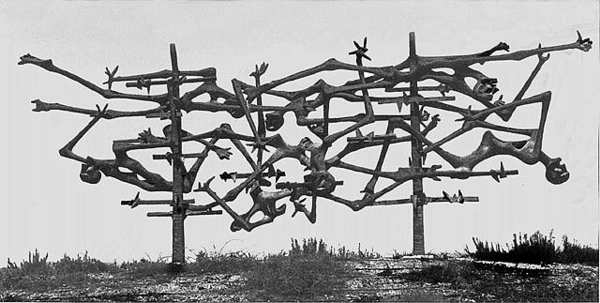
Over the years, our
attention has been drawn to the close proximity of the
village of Deir Yassin to the Jewish Holocaust memorial
at Yad Vashem. Jews have been encouraged to visit Deir
Yassin, the symbolic starting point of nearly six decades
of Palestinian dispossession, and from there to look
across to Yad Vashem. Palestinians (if only they could!)
have also been asked to visit Yad Vashem - the symbol of
Jewish suffering - and to look across the valley toward
the birth site of their own tragedy.
Everybody was happy. Jews of conscience were of course
pleased to see Jewish suffering again at the centre of
the discourse but also happy to extend their narrative of
suffering to include Palestinians. Palestinians were
perhaps less pleased at having - yet again - to
acknowledge Jewish suffering in order to help achieve
their own liberation, but they recognized the importance
of the publicity that the link between Deir Yassin and
Yad Vashem brought to their cause.
Of course, one had to be careful. As is so often the case
with these things, there was always a but. After all, who
in their right mind would compare the massacre of a
hundred Palestinians at Deir Yassin with the
industrial-scale slaughter of six million Jews? And who
would dare draw comparison the 1948 expulsion of over
750,000 Palestinians to the near-successful attempt at
physically exterminating every last Jewish man, women and
child in Europe?
Both atrocities have seen their fair share of deniers
over the years. Many Zionists, either with conscious
intent or out of ignorance, have denied Deir Yassin.
"There was no massacre at Deir Yassin," they
say; "It was simply a battle - a battle that the
Palestinians lost. These things happen in war and anyway,
they did the same to us." Also, "No, the
Palestinians were not expelled; they ran away, and
anyway, they didn't love the land as we love the land -
just look how neglected it was until we came along to
make the desert bloom."
The Holocaust too has come under assault. Over the last
fifty years, revisionist scholars have amassed a
formidable body of substantial evidence, which runs in
direct opposition to the traditional Holocaust narrative.
"Where is the evidence," they say, "for
this alleged gargantuan mass-murder? Where are the
documents? Where are the traces and remains? Where are
the weapons of murder?" These revisionists all
acknowledge of course, that there was a terrible assault
on Jews on the part of the National Socialist government,
but disagree as to the scale, motive, and methods cited
in the typical narrative, a narrative that most of us
choose or are obliged to accept. "What befell the
Jews", they say, "was a brutal ethnic cleansing
accompanied by dispossession, pillage and massacre."
A brutal ethnic cleansing accompanied by dispossession,
pillage and massacre… terms surely familiar to any
Palestinian.
But no matter how similar the Jewish and Palestinian
histories of suffering may seem, the similarities conceal
important differences:
First, by all accounts, and according to any version of
the events, what was done to the Jews of Europe took
place a long distance from Yad Vashem, while what was
done to the Palestinian people took place right there at
the village of Deir Yassin and right there throughout the
whole of Palestine.
Second, the perpetrators of the atrocity against Jews had
nothing to do with Palestine or Palestinians, while
perpetrators of the Palestinian tragedy were and are
Jews.
Third, the perpetrators of the atrocity against Jews have
been roundly condemned over the years and punished for
their crimes, and have mostly shown contrition, while the
perpetrators of the massacre at Deir Yassin have been
honored for their crimes, continue to take pride in them,
and live on in their ideology and in their deeds.
Fourth, what befell the Jews had a beginning, a middle,
and an end, while the assault on the Palestinians goes on
with no end in sight.
And one final difference: If the living evidence for the
veracity of the Holocaust narrative is a safe, secure and
empowered Jewish people, at home wherever they may be,
the living evidence for the veracity of Deir Yassin and
the Nakba is a Palestinian people dispossessed and exiled
and longing to go home.
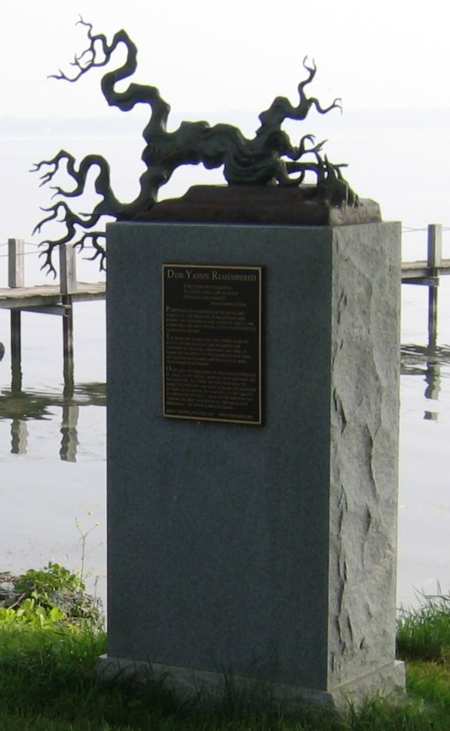
Paul Eisen, Director
Deir Yassin Remembered