| THE HANDSTAND | MAY2011 |
Blindness
Toward War Easy for Americans
By John R. MacArthur
April 28, 2011 "Harper's Magazine" -- To understand the
utter absurdity of America’s intervention in the
Libyan civil war, I recommend a visit to the Museum of
Modern Art in New York to see its new exhibition of
German Expressionism. It will be much more instructive
than reading the media commentary about the
president’s opening of yet another Mideast war.
I’m not merely referring to the surrealism (in the
work of the artists Ernst Kirchner, Emil Nolde and Max
Beckmann) of Nicolas Sarkozy’s “leading” a
coalition of the righteous against the evil Moammar
Gadhafi, who not so long ago was the French
president’s honored guest in Paris. Nor am I
alluding to the stupidity of entering a sectarian battle
(the German Expressionists were deeply affected by the
overthrow of Kaiser Wilhelm II and the factional fighting
that followed in 1918-19) in which the goals and
personalities of the opposition leaders are largely
unknown; or even to the hypocrisy (the Expressionists
were big on pointing out moral hypocrisy) of Barack Obama,
once considered the anti-Bush, who now wages his very own
“war of choice” without bothering to ask
Congress for permission.
No. I’m talking about the growing divide between
American illusion and 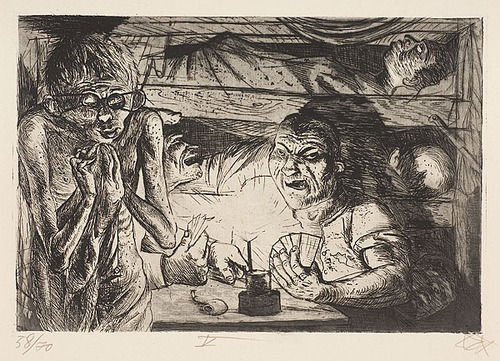 the reality of war. Because we
have been largely cut off from images of corpses and
carnage since the invasion of Grenada — whether by
official censorship or self-censorship by the timid U.S.
media — Americans no longer have the capacity to
connect military action with the casualties of war.
Evidently, they think very little about the consequences
of firing millions of bombs, bullets and missiles at
distant targets occupied by unknown foreigners. Nowadays,
with only 0.5 percent of Americans in the military (compared
with 8.6 percent during World War II), we have relatively
few witnesses to the butchery of soldiers and civilians
who can come home to tell their stories.
I don’t know war up close. Thankfully, I’ve
only gotten to hear the accounts of others who suffered
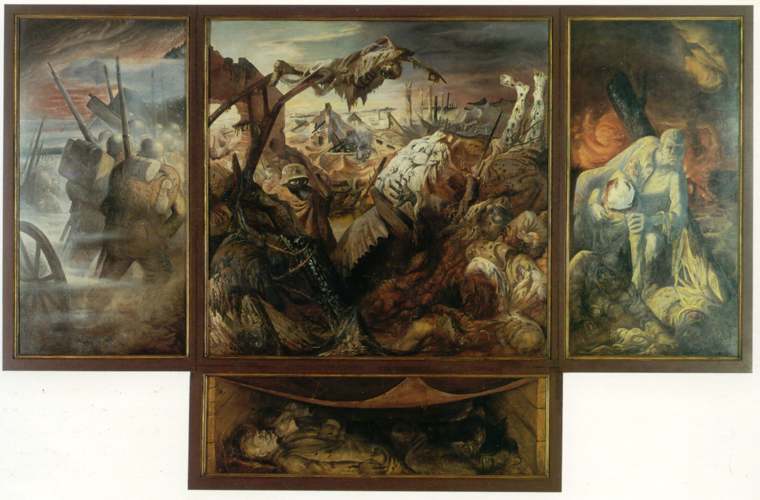
through World War II and Vietnam. Even so, the MOMA
exhibition grabbed me by the throat, since the German
Expressionists, in particular Otto Dix and Max Beckmann,
understood war quite well, having endured trench warfare
during World War I.
The work of these artists before the war already
wasn’t easy on the eye — their graphic style
and printing techniques were disorienting, subversive and
sometimes hideous — but the movement had sufficient
idealism, says the MOMA show’s curator, Starr Figura,
to believe “in art’s ability to transform
society.” After the war, “Expressionism
withered,” writes the historian Peter Jelavich.
“As an art and a lifestyle, it was too dependent on
an optimistic vitality that could not withstand the
combined shocks of wartime and post-revolutionary trauma.”
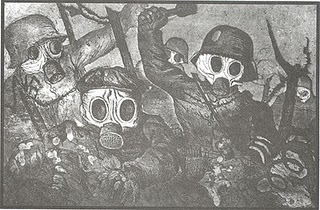
The MOMA exhibition devotes an entire wall to 50 prints
by Dix titled “Der Krieg” (“The War”).
These terrifying pictures — the hideously wounded, a
skull invaded by worms, monstrously disfigured faces, the
dead and the living dead — confront the viewer with
the fact that war’s impact stretches far beyond
physical damage to buildings and flesh. Dix’s genius
is in depicting the destruction of the human spirit that
results from decisions made by politicians who never
experience the direct effects of war. I applaud Rolling
Stone magazine for publishing photos of Afghan civilians
murdered by leering American soldiers (also Paris Match
for its photo of two Libyan soldiers torn to pieces by
NATO bombs), but Dix’s prints surpass
photojournalism in their emotional reach.
Nowadays, with wars often waged from on high or from very
far away by pilots, sailors and computer programmers who
never encounter their victims, it’s easy to be blind.
Phony talk about “targeted” and
“precision” bombing, “no-fly zones,”
“protecting civilians” with air strikes and
“limited” war designed to prevent
“massacres” (as opposed to the actuality of
overthrowing the West’s favorite
“reformed” Arab dictator to stabilize Libyan
oil exports and boost Sarkozy’s low poll numbers) is
intended to hide the horror of war. There’s no such
thing as a wholly “just” war and certainly not
a “clean” war.
Nevertheless, there is a paradox in Dix’s work and
life that might help indifferent Americans empathize with
the victims of war. Although Dix (a machine-gunner in the
Kaiser’s army) was celebrated as an “anti-war”
artist, he remained ambivalent about the organized
killing that such statesmen as Obama and George W. Bush
prefer to euphemize in slogans like “the war on
terror.” In 1961, nearly four decades after
“Der Krieg” appeared, Dix said that “the
war was a horrible thing, but still something powerful. .
. . Under no circumstances could I miss it!”
Elsewhere, he said he had wanted to “experience
everything very precisely. . . . Hence I am no pacifist.
Or perhaps I was a curious person. I had to see
everything myself.”
In justifying the attack on Gadhafi’s forces, our
president piously declared that “some nations may be
able to turn a blind eye to atrocities in other countries.
The United States of America is different.”
Perhaps without knowing it, Obama has presented a
wonderful opportunity to educate the citizenry, and with
a patriotic justification to boot. From now on, all
Americans should proudly open their eyes to atrocities
committed by their armed forces abroad. For a little
recent history, they could begin by traveling to Hanoi,
Panama, Baghdad, Kabul and Benghazi. They would surely be
edified by what they found, and maybe a little wiser.
John R. MacArthur is publisher of Harper’s Magazine and author of the book You Can’t Be President: The Outrageous Barriers to Democracy in America. This column originally appeared in the April 20, 2011 Providence Journal.
© The Harper's Magazine Foundation