october 2004
'Black American in
Paris'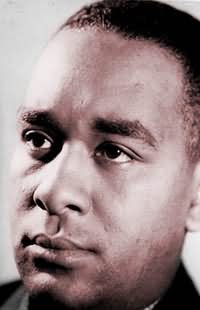
by James Campbell
In the spring of 1960, the year of his death, the
novelist Richard Wright wrote from Paris to his friend
and Dutch translator Margrit de Sabloniè thus:
You must not worry about my being in
danger.... I am not exactly unknown here and I have
personal friends in the de Gaulle cabinet itself.
Of course, I don't want anything to happen to me, but if
i does my friends will know exactly where it comes
from.... So far as the Americans are concerned, I'm
worse than a Communist, for me work falls like a shadow
across their policy in Asia and Africa.... They've
asked me time and again to work for them: but I'd rather
die first.
This letter contains the essence of John A.
Williams's roman à clef, The Man Who Cried I Am, first
published in 1967. Wright, an ex-Communist who had turned
his back on the party and moved to France in 1946 but had
never succeeded in throwing off the attentions of the
American government, died unexpectedly in a Paris clinic
eight months after writing those words to Sabloniè in
Leiden, Holland, and their eerie prescience has kept
speculation about his death smoldering ever since. The
Man Who Cried I Am, which opens in Leiden, brings a
heavy load to the fire. It charts the journey through the
1940s and '50s of Max Reddick, a black novelist and
journalist, leading up to the death of Reddick's friend
and mentor, Harry Ames. Harry is an expatriate former
Communist living in Paris with a white wife and a career
on the slide. "I'm the way I am, the kind of writer
I am, and you may be too," he tells Max early in the
novel, which proceeds by way of flashbacks and a jigsaw
structure, "because I'm a black man; therefore we're
in rebellion; we've got to be. We have no other function
as valid as that one."
This repudiation of writing that is not
politically committed sets the tone of The Man Who
Cried I Am. In the parallel, real-life story that
runs a few feet below the surface of Williams's novel,
Harry's
remark also serves as a dismissal of James
Baldwin's famous attack on Richard Wright as the author
of "protest fiction" in his precocious essay
"Everybody's Protest Novel," published
in Partisan Review in 1949. Harry Ames is decisively
committed, or as his French friends would have said,
"engagé". Harry has long been a thorn in the
flesh of the American government, and Max suspects that
someone--even someone from among their own cafe
circle--was deputed to kill him.
For Max, Harry's very existence was a challenge to
white power; so his death is one more deferment of the
dream of racial justice. The consequences, as set out
here, are likely to be apocalyptic. Williams was surely
in earnest in predicting a bloody reckoning, for he
followed The Man Who Cried I Am with Sons of
Darkness, Sons of Light, a story written in the late
1960s but set in the next decade, with the uprising about
to begin.
Wright was the pioneer and leader of a school of
black writers who left behind the hazards of daily life
in the United States in the late 1940s and early '50s for
the comparative freedoms of France. Those who followed
included not only Baldwin but also Chester Himes, William
Gardner Smith and Richard Gibson. In his journal in
January 1945, a year before his migration, Wright
described Paris as "a place where one could claim
one's soul."
That Harry Ames is a dead ringer for Richard
Wright nobody would deny, least of all John A. Williams.
In the 1990s, while researching a book about Anglophone
literary life in Paris after the Second World War, I
asked Williams if it was fair to make the connection
between Ames and Wright. He said it was. When asked if
Wright might have been been assassinated by the American
security services, Williams replied, "I would say
his death was highly suspicious" (he added, "I
wouldn't put it any stronger than that"). His
suspicions arose from conversations with people who were
in France at the time of Wright's death, most notably the
novelist Chester Himes, who had been close to Wright
though the two were by then estranged. Asked why the
government would risk murdering a writer who was no
longer a force in the civil rights movement, Williams
said, "I do believe there is such a thing as
teaching people a lesson."
The official cause of Wright's death on November
28, 1960, was the obstruction of a coronary artery--a
heart attack. His body was cremated, without a
post-mortem. Almost immediately, rumors began to
circulate that he had been poisoned. A mystery woman was
said to have visited his bedside an hour before he died.
There was talk of an urgent telegram dispatched from the
clinic. In his memoir, My Life of Absurdity,
Himes named a "soul brother" by whom Wright
felt he "was being persecuted." More
than thirty years later, a friend of Wright from Paris
days, the cartoonist Ollie Harrington, told me, "I
know Richard Wright was assassinated" (despite
promptings, he remained vague as to how he knew).
Speaking on a BBC radio program about her father in
October 1990, Julia Wright put it more subtly, giving
credence to "a CIA plot to isolate him, in order to
make him more vulnerable," thus fatally undermining
his health. After a poorly attended service--Wright's
wife, Ellen, had wished to keep it closed--the author's
ashes were interred in Père Lachaise cemetery. In The
Man Who Cried I Am, Max attends Harry's funeral in
Paris: "Charlotte, Harry's wife was there, a few
Americans.... There were some Africans, a few Indians.
And it was only twenty hours after Harry had died."
The Man Who Cried I Am is the kind of
novel that many novelists dream of writing--a bulging bag
that seems to contain everything the author knows about
life. It is a book that hums with sound and smell, and a
good deal more hate than love. Its greatest strength is
in making the reader feel the height and solidity of the
oppressive wall that Max, Harry and others must negotiate
daily, just to hoist themselves up to safety, to be able
to say, "I am." In his introduction to the new
edition, Walter Mosley compares it to The Odyssey and Max
to Odysseus. "And the journey home is more dangerous
than Odysseus could ever imagine," he writes with
reckless abandon. The minutiae of Max's existence are
crammed in, from his talent to his paranoia, down to his
culinary skills. An odd touch of authenticity is added by
the graphic descriptions of a rectal illness that plagues
him throughout. The Man Who Cried I Am takes
lungfuls of breath from the author's angry energy, and
from his ability to convey to the reader his belief that
he is uncovering hidden truths.
While Williams succeeds in bringing Max Reddick to
life, he fails to make him likable. Max is a bristling
bundle of conspiracy theories, glued together with hatred
for white men and desire for white women. The latter
seems at times closer to sadism than affection. Nothing
good happens to Max--a job at Pace magazine (for Pace,
read Time), a White House speechwriting assignment--that
is not the product of white men's cynical maneuvering.
There is scarcely a white male character who isn't a
creep, and hardly a white female character who is not the
target of the "cocksman" Max fancies himself.
From one point of view, it is a bravura depiction of a
peculiar pathology. From another, it feels as if
Williams, intending to create a hero, has brought into
being an emotional Frankenstein.
Williams emerged as the patience of the civil
rights movement was hardening to anger, and he has always
been an angry writer. His books are apt to take anger as
a viable substitute for morality. His first novel was
called The Angry Ones. In 1962 he edited a collection of
writings called The Angry Black, to which he himself
contributed a story about a writer, Wendell, who tries to
seduce a white woman in her own home. She first welcomes
his advances, then tries to disengage herself as her son
is heard approaching, but Wendell holds her in a clinch
just long enough for the 9-year-old to see them. By any
standard of decency, Wendell's rationale is tantamount to
child abuse: "no matter how his mother explains it
away, the kid has the image for the rest of his
life."
It is a form of revenge that Max Reddick could as
easily have taken. In Max's eyes, bad luck is a stranger
to whites--"What have you got to be nervous
about?" he teases an associate. "You're
white"--whereas almost every misfortune in a black
life is traceable to color. Such an apprehension is
enough to drive someone mad, and at times, rereading this
novel, I felt that Max had taken leave of his senses.
"Dying violently was a European habit," he
reflects at one point, thinking of a French friend:
All other deaths were commonplace. A European
learned by his condition to expect catastrophe and
invariably that was exactly what he received. In Europe,
a winner was one who bested those common deaths
arbitrarily assigned to others. You crawled, kissed
behinds, ate merde, and grinned like you loved it. Living
was everything. The final act of death was of no
consequence; it was the living while everyone around died
that counted.
Max's sexual politics are likely to seem equally
unappetizing to a present-day readership (and probably
did to many in 1967). Women are there for the taking. Max
is the kind of fellow who passes the time in his office
making lists of those he has slept with. He and Harry
keep up a running joke about the unique delights of
"redheads." The novel is shot through with
reflections such as this, on Max's Dutch girlfriend,
Margrit: "Time sped by. Now, she was almost thirty.
In Europe that made you an old maid or a lesbian. Or a
whore. Managing an art gallery hadn't helped. She had
gone through a couple of painters, or more correctly,
they had gone through her."
To what extent the reader is expected to
accommodate Max because, as he says, "it was bad
when I was born" (i.e., "born black"), is
unclear, but I suspect that Williams feels he should be
indulged quite a bit. Max certainly does. He lacks the
faculty of self-examination. For example, he is said to
be unpopular at the houses that have published his novels
because "he...liked white women." Presented
this way, it sounds like blatant racism, but might not
the publishers simply be collating the observation about
his love life with an insight Max provides into his own
character: "Max had already given himself a name; he
was a pimp without briefcase.... you borrowed money from
the girl and the girl knew you'd never pay it back, and
chances were, every time you met you'd borrow more
money"? In Max's endlessly self-justifying hatred of
the outside world, his
tireless generalizing, there is no need for
self-scrutiny, for every personal criticism can be
deflected by the countercharge of racism.
Various figures who circled in Wright's orbit
during his fourteen years in France are depicted under
light disguise in The Man Who Cried I Am. A
scene in a Left Bank cafe, involving Max, Harry Ames and
a young disciple of Harry's called Marion Dawes, is a
rough rendering of a meeting that took place in the
spring of 1953 between Wright, Himes (the character of
Max contains elements of Himes) and Baldwin. It was
during this stormy encounter, recorded by all three
principals, that Baldwin gave warning to Wright,
"The sons must slay the fathers." In the first
volume of his memoirs, The Quality of Hurt, Himes
described the incident, adding that he thought at the
time that Baldwin had gone crazy; "but in recent
years I've come to better understand what he meant."
No such empathy is extended to the Baldwin
character, Marion Dawes, who is treated unkindly. Baldwin
and Williams, almost exact contemporaries, were never
close, and it's hard to imagine that
Baldwin would have been amused to see himself as
Marion Dawes, whose homosexuality makes him a target for
Max's disgust and ridicule. (It is suggested that Dawes
gained a fellowship by means of which he moved to France
by sleeping with certain people; in real life, Baldwin
got a Eugene F. Saxton award on the recommendation of
Wright.) Crucially for Max and Harry, Dawes is not a
"writer in rebellion." The young Baldwin's
concerns were more aesthetic than political, and he spent
his nine years in Paris coaching his heart to exorcise
the outrage that he feared would kill him if left to
fester. Max, on the other hand, is consumed by anger. He
cannot pick up the telephone without seeing it as
"another one of the white man's inventions,"
and reflecting that it was "ironic that one must
inevitably come to use the tools of the destroyer in
order to destroy him, or to save oneself."
Near the end of the novel, Max is trying to relay
to a Malcolm X figure, Minister Q, the contents of a file
discovered among Harry's papers, which outlines the King
Alfred Plan, an FBI- and CIA-designed scheme to
"terminate, once and for all, the Minority
threat" and to consolidate the league of nations
known as the "Alliance blanc," or White
Alliance. In his afterword, Williams compares the King
Alfred Plan, his own invention, to intelligence programs
devised by J. Edgar Hoover in the 1960s to monitor the
movements of black militants, which did not become public
until much later. Harry is already a victim of the King
Alfred Plan, and Max fears that he is about to
become another.
The Man Who Cried I Am is an absorbing
story about the way some people were thinking and acting
in the 1950s. It is driven by a furious beat, and
constantly illuminated by the real-life drama
behind the fictional one. It is let down by loose writing
and a lack of generous characterization. The latter may
be ascribed to Max's solipsism, and no doubt there are
powerful psychological reasons for that, but a solipsist
is hardly a trustworthy guide. Walter Mosley's ingenious
classical comparison must be tested against the objection
that Max is not a tragic hero but a pathetic one, wounded
as much by vanity and self-pity as by racism.
Does the conspiracy theory about Wright's death
have any basis in reality? No one has provided a shred of
forensic evidence to support the notion that he was
murdered. From another angle, however, it is possible to
argue that Wright's premature death was willed by the
state. In the early 1990s, I visited Wright's widow,
Ellen, in her apartment in St-Germain des Près. She
spoke about Wright's quarrels with Baldwin and others,
and said how futile it all seemed to her now that
these great men were gone. "My husband lived with
tension all his life," Mrs. Wright said. "Every
day, awful tension." If there is an
alternative cause of death to be inserted beside the
official entry on Wright's records, then that is surely
it.
This article can be found on the web at:
http://www.thenation.com/doc.mhtml?i=20040927&s=campbell
From: Malik Al-Arkam .The BlackList@topica.com
haiku |